Saturday, June 25, 2005

The Road Not Taken

The Supreme Court's Kelo v. New London case, decided Thursday, provoked much wailing and gnashing of teeth. Most of the outrage and alarm comes from fellow conservatives and conservative media, calling the case "a devastating blow" to property rights, an endorsement of "Soviet-style planning."

As a service to our Martain readers, a bit of background. The Fifth Amendment forbids governmental (including state government) seizure of private property except where "taken" for a "public use," returning "just compensation" to the property holder. Kelo considered a New London, Connecticut, scheme to redevelop and revitalize 90 acres declared a “distressed municipality" 15 years ago. The city-approved plan transferred municipal eminent domain authority to a non-profit corporation, which condemned, and compensated, property plots and committed to build (both by itself and by leasing some parcels to for-profit companies) the "small urban village" (hereinafter, SUV) detailed in the plan. The SUV specs are so hip and groovy, they're confined to small-print footnotes.1

Anyway, some owners were equally unimpressed: declining to take the money and run, they sought a state-court injunction that the condemnation rewarding private individuals, was not a lawful "public use." Intrigued by hip and groovy SUVs for his can't-happen-soon-enough retirement, Justice Stevens authored the 5-4 majority opinion blessing the plan as a Fifth Amendment "public use."2

Alarmists say Kelo's a communitarian assault on the sanctity of property;3 a communist infiltration of our homes; a starter-gun for class warfare and income redistribution; another unconstitutional amendment to the supposedly "living Constitution." Now, I've got season tickets for DC's perpetual production of "No, No, Anthony!". Occasionally the role of Kennedy is performed by an understudy, including Souter, Stevens, O'Connor, Breyer or (occasionally) Rehnquist and Scalia. I yield to none in admiration of Justice Thomas and contempt for instigators of our "Gumby Constitution." I've no doubt Mark Levin's correct that, "This has been one of the most miserable Supreme Court terms in years." And I turned conservative in part because of Amendment Five/property rights/law & econ/Hernando De Soto,4 etc. Damn proud of it too.

Yet Kelo don't bother me. I expected the outcome, am not overly troubled by its rationale, and don't anticipate significant deterioration of property rights, for three reasons:
  1. Text: In brief, one could read "public use" as narrower than, for example, "public purpose," requiring either municipal ownership, or continuous public access. Justice Thomas does just that, arguing it's the "most natural reading of the Clause." Thomas, of course, is a process-oriented Constitutional "originalist," which is to say a near-libertarian. Not that there's anything wrong with that--I've applauded his approach before. In some ways, Justice O'Connor's Kelo dissent one-ups Thomas, saying a state's announced and legitimate decision to foster economic development, thus encouraging growth, thus increasing the tax base, and attracting new visitors and residents can't qualify as a "public use" if new private owners exclude the public from even a sliver of once-condemned land.

    But I depart from Thomas and O'Connor, for three reasons. First, I'm unconvinced the words compel such a restricted reading. If the Constitution imposes the law of the excluded middle, eminent domain property could suddenly, repeatedly, but unpredictably oscillate between outlawed and OKed. For example, why should "public" mean "all members of the public?"--does that disqualify a state owned and operated payroll building unless it allows anyone access to the safe? How about a girls-only High School? Is a municipally owned Ferris wheel unconstitutional by virtue of a "you must be taller than" sign? Why does "use" necessitate continuity?--even city parks close at dusk. Why must "use" imply perpetuity?--there's no evidence of restraints on who can lease, bid or purchase commercial or residential space in the completed SUV. Why read the Fifth Amendment to block housing assistance programs from using increasingly preferred vouchers just because a low-income project was initiated via eminent domain?

    Second, Justice Thomas' impressive history is somewhat inapposite. His examples mostly predate the advent of truly private corporations, much less the modern and extensive version. And, obviously, this interpretation is not easily squared with the long-standing judicial approval of private entities in the eminent domain process, discussed below.

    Finally, Thomas' approach departs from essentially all prior takings decisions, as he forthrightly acknowledges:
    Our cases have strayed from the Clause’s original meaning, and I would reconsider them. . .

    When faced with a clash of constitutional principle and a line of unreasoned cases wholly divorced from the text, history, and structure of our founding document, we should not hesitate to resolve the tension in favor of the Constitution’s original meaning.
    Of course, impracticality cannot excuse unconstitutionality. Still, everyone concedes incorporation's unsupported and unoriginal, but few would fix it.5

    Jonathan Adler, NRO contributing editor and associate professor at Case Western Reserve University law school, School of Law, wouldn't launch a takings crusade, "while I would like to read 'public use' as a strict limitation on government use of eminent domain for a small set of purposes, there is little warrant for this interpretation in either the ratification history or the court's jurisprudence of the past 100 years or so." Thomas' Fifth Amendment originalism could occupy a hundred Supreme Court clerks at a hundred word processors for the next hundred years.6 Is it wrong to suggest conservative resources are better deployed elsewhere?


  2. Precedent: Why was Kelo a shock? Not universally of course; some weren't surprised. But most called Kelo "statist," contrary to historical evidence, an assault on "innocent homeowners," proof it's not our land. Are they right?

    No. As Justice Thomas documents, the Court's repeatedly upheld state laws resulting in actual or potential economic loss--classifying them as less invasive than a taking thus sanctioning economic loss without compensation. For example, the Justices historically OKed un-compensated municipal zoning ordinances so long as reasonably crafted to enhance the general welfare. Village Of Euclid, Ohio v. Ambler Realty Co., 272 U.S. 365, 389-90, 395 (1926). Further, the Justices routinely endorse regulations generating unequal loss or benefits -- even those compelling a business to close -- again without compensating property owners. Miller v. Schoene, 276 U.S. 272, 279 (1928) ("[When] making a choice between the preservation of one class of property and that of the other . . . the state does not exceed its constitutional powers by deciding upon the destruction of one class of property in order to save another which, in the judgment of the legislature, is of greater value to the public."). By contrast, the Kelo Petitioners opposed the plan despite their unquestioned entitlement to compensation.

    Kelo's also consistent with takings precedent. Berman v. Parker, 348 U.S. 26, 34 (1954) approved delegating authority to private corporations:
    The public end may be as well or better served through an agency of private enterprise than through a department of government - or so the Congress might conclude. We cannot say that public ownership is the sole method of promoting the public purposes of community redevelopment projects.
    And, most relevantly, a unanimous Court7 in Hawaii Housing Authority v. Midkiff, 467 U.S. 229 (1984), found "private-to-private" takings consistent with the "public use" clause so long as "rationally related to a conceivable public purpose."

    In sum, Kelo's mostly a combination of prior rulings. The outcome shouldn't startle. Indeed, the only astonishment is Justice O'Connor's dissent because, as Nicole Garnett observes, she wrote Midkiff: "The surprise is the stridency of the O'Connor dissent, in light of her questions at oral argument, her Midkiff opinion, and the language of Lingle."


  3. Federalism: Kelo critics see a slippery, authoritarian slope. Kevin concludes America's "Sprinting towards despotism." Andy McCarthy sees a new Star Chamber: "Though safe from the government in their homes, the homes themselves are not." "Tyranny," says Tran. And MaxedOutMama predicts "oligarchy":
    A developer pays to do a study confirming that the property it wants to develop could be more profitable to the community, it presents the study, and the municipality condemns the property and gives it to the developer. This ensures that the developer doesn't have to undertake the arduous and expensive route of actually negotiating with the property owners.
    M_O_M also believes Kelo "laid the foundation for an overwhelming incursion of federal power upon state's rights and individual's rights."

    The critics have it backwards. Kelo upholds states rights. Conservatives support states rights Federalism, to counteract over-centralization, to authorize state-by-state experimentation and competition, to devolve authority to the smallest possible (and thus most representative) unit of government. Kelo vindicates local and elected officials at the expense of anti-majoritarian judicial whim.

    Sure, Kelo marginally increases property rights uncertainty--though I think it still safe. And Midkiff begat massive income redistribution in the socialist republic of Hawaii, including "Peter-to-Paul" transfers with minimal governmental participation. I doubt either program will fulfill the hype. But I now know to avoid a Connecticut or Hawaii domicile. Forewarned is forearmed -- and Federalism.

    This tempest is telling. Apparently, conservatives found Kelo so unnerving they're now anxious about corporate control and fearful of the local Mayor. For the past 48 hours, the Right temporarily turned liberal, as their own rhetoric demonstrates: Many, longstanding and reliable conservatives -- including the handful infiltrating the MSN -- object in a style indistinguishable from anti-Bush, anti-war leftists. But Kelo isn't the devouring commerce clause of Gonzales v. Raich, nor is a redeveloped SUV a harbinger of Zimbabwe. Most alarmingly, normally sober conservatives sound like the nonsensical "blame-Wal-Mart-first" crowd.

    Relax; take a deep breath; exhale. Sure, some developers are Music Man frauds; some local government officials on the take. But the law doesn't presume criminality; criminals are deterred and punished under state criminal laws.

    At bottom, Kelo's both conservative and Federalist. Discarding current takings law would void Midkiff's refusal to "substitute its judgment for a legislature's judgment as to what constitutes a public use" and its reminder that "debates over the wisdom of . . . socioeconomic legislation . . . are not to be carried out in the federal courts." 467 U.S. at 241-43. Overturning Lingle v. Chevron U.S.A., No. 04—163 (May 23, 2005), would erase its determination to avoid "scrutiniz[ing] the efficacy of a vast array of state and federal regulations–a task for which courts are not well suited [and] empower–and might often require–courts to substitute their predictive judgments for those of elected legislatures and expert agencies." The Constitution's already too "living" to waste Berman's insistence that "the legislature, not the judiciary, is the main guardian of the public needs to be served by social legislation." 348 U.S. at 32.

    We got what we wanted--deference to state authority and limits on public interest busybodies or NIMBY neighbors. So why is everyone acting like we lost?
Conclusion: Like me, NRO's Jonathan Adler disfavors governmental interference with property rights. And like me, he calls for consistency, "If conservatives are to be taken seriously when they call for judicial restraint, we have to be willing to accept decisions that allow state legislatures to get away with idiotic things -- such as the use of eminent domain at issue in Kelo." On balance, Adler properly supports stare decisis over judicial restraint:
[T]he fact remains that state and local governments have a fair amount of power under our constitution to enact either. We often tell folks on the left that not every social ill should be cured by the courts, and that should apply no less when "conservative" interests are at stake.
Unrestricted eminent domain would be unconstitutional. But Kelo demands no such thing. Rather, it bolsters a bit of judicial deference commonly confined to the legal endangered species list.

I refuse to assume the sky is falling. At most, the Kelo case may foster increased civic attention to, and participation in, state and local government decision-making. Which is no bad thing--and better than bowling alone.

__________________

1 Caution--Affix Shades Before Reading The plan includes a waterfront conference hotel, restaurants and shopping, recreational and commercial marinas, a pedestrian “riverwalk,” approximately 80 new residences, a new U.S. Coast Guard Museum, 90,000 square feet of research and development office space, and other “office and retail space [and] parking.” The plan was spurred, in part by the pharmaceutical company Pfizer’s decision to build a $300 million research facility immediately adjacent to the newly planned 90 acres. In addition to creating jobs, generating tax revenue, and helping to "build momentum for the revitalization of downtown," the city predicted redevelopment would enhance its attractiveness. Slip op. at 3.

2 "You know what that means!"--Kelo confirms in Connecticut, it "takes" a village. (The best I could do; suggestions welcome.)

3 In the absence of contrary facts, the Court assumed the Petitioners weren't Connecticut Hillbillies, and the properties at issue were neither "blighted or otherwise in poor condition" but "condemned only because they happen to be located in the development area." Slip op. at 4.

4 A law school prof claimed my copy of the Bill of Rights printed Amendments 3, 4, 6, 7, and 8 in invisible ink. I said his version left out 2, 10 and the word "property." (I'm not making this up.)

5 National Review's Ramesh Ponnuru certainly is brave--probably because he's not a lawyer:
If good originalists are supposed to ignore 100 years of bad precedent, and incorporation amounts to a series of bad precedents, then shouldn't good originalists be trying to undo incorporation too? You argue that it is "too late in the day to argue" against incorporation either in general or even in the specific case of the Takings Clause. If so, why is it not too late in the day for Thomas to argue against these other precedents?
6 The advantages of secreting a hundred additional Law Review editors for a century suddenly seem compelling.

7 O'Connor's Midkiff majority was 8-0; interestingly, Thurgood Marshall did not participate because his wife's family held leases the law would convert to fee simple ownership, presumably at a higher value.

Friday, June 24, 2005

Secular Discrimination

The Bob, Carol, Ted and Alice of the blogosphere (left, right, secular, tolerant) launched by Kevin, continuing at True Grit, here at NOfP, and MaxedOutMama, generated interesting comments. He's a reply to a few.
  • Dan goes further, arguing secular liberals discarded all morality. While I agree that the invention of the pill was the Fort Sumter of a Second Civil War against Judeo-Christian ethics, augmented by abortion and pants suits" liberals aren't against all constraints--they're just swapping in new absolutes. Ilona, SC&A and M_O_M agree, M_O_M calling the left's morality a soupcon of pessimism blended with the isolationismand the refusal to seek, or identify, evil. I agree with them--and with SC&A and Dan that Radical Islam's cranked the moral machine knob up to "11." As previously mentioned, so long as a sizable percentage of the faithful retain the Koran's cradle-to-grave, head-to-toe dictates and blend worship with government, the feared "clash of civilization" is a race against time:
    Where the West started dis-entangling worship from statecraft as far back as 1648, the Koran recognizes no distinction between Islam the religion and Muslim nation state governance. The West no longer struggles against the Islamic world, yet many Muslims still "divide[] the world into two spheres, known as the Dar al-Islam--the "house of Islam" or "house of submission" to God--and the Dar al-Harb, or "house of war"--those who are at war with God. . .

    [P]eace between the West and followers of radical Islam can come only after Islam undergoes something like the Protestant reformation, a "Martin al-Luther" who can distinguish between state and mosque.
  • boomr took issue with my tone and disputed my previous points:

    1. boomr's approach: His doctrine deprecates the intelligence and sincerity of opponents, by equating religion with irrationality and forcing the faithful -- but only the faithful -- to supply additional justification independent of and without reference to religion. And if Judge boomr can't spot a "non-religious purpose," he'd exclude or hinder that viewpoint from the public and political spheres. Put differently, boomr suggests a content-dependant censor to silence the sacred.


    2. Neutrality: I say secularism is neither private/personal nor value neutral. boomr's defense only argues it's more neutral than religion. I disagree; and his use of "opposition" suggests he secretly agrees. If neutrality has opposition, it can't qualify for the center square. Is boomr conceding? Are we playing out the old joke?--agreeing on what you are; arguing only about price.


    3. Quo Warranto?: I don't understand how boomr denies advocating "supression." His argument treats opponents as cretins whose dim reasoning ensures every "vague" "extrapolat[ion]" will be "unsubstantiated." Can he point to any provision authorizing citizens, backed by police powers, to discount another's belief? Someone, anyone, dig up the authority to condition the liberty of believers on evidence of divinity without transgressing religious freedom.

      Don't bother--the cases virtually outlaw the content-based restrictions boomr prefers:
      "Freedom of thought, which includes freedom of religious belief, is basic in a society of free men. West Virginia State Board of Education v. Barnette, 319 U.S. 624, 670 (1943). It embraces the right to maintain theories of life and of death and of the hereafter which are rank heresy to followers of the orthodox faiths. Heresy trials are foreign to our Constitution. Men may believe what they cannot prove. They may not be put to the proof of their religious doctrines or beliefs. Religious experiences which are as real as life to some may be incomprehensible to others. Yet the fact that they may be beyond the ken of mortals does not mean that they can be made suspect before the law. . . [even though the] religious views espoused by respondents might seem incredible, if not preposterous, to most people." United States v. Ballard, 322 U.S. 78, 86-87 (1944).
      "If judicial inquiry into the truth of one's religious beliefs would violate the free exercise clause, an inquiry into one's reasons for adopting those beliefs is similarly intrusive. So long as one's faith is religiously based at the time it is asserted, it should not matter, for constitutional purposes, whether that faith derived from revelation, study, upbringing, gradual evolution, or some source that appears entirely incomprehensible." Callahan v. Woods, 658 F.2d 679, 687 (9th Cir. 1981) (citation omitted), quoted in Hobbie v. Unemployment Appeals Comm'n Of Fla., 480 U.S. 136, 144 n.9 (1987).
      "[U]nder the Equal Protection Clause, not to mention the First Amendment itself, government may not grant the use of a forum to people whose views it finds acceptable, but deny use to those wishing to express less favored or more controversial views. And it may not select which issues are worth discussing or debating in public facilities. There is an "equality of status in the field of ideas," and government must afford all points of view an equal opportunity to be heard. Once a forum is opened up to assembly or speaking by some groups, government may not prohibit others from assembling or speaking on the basis of what they intend to say. Selective exclusions from a public forum may not be based on content alone, and may not be justified by reference to content alone." Police Department Of Chicago v. Mosley, 408 U.S. 92, 96 (1972).
    4. Eradicating without Evidence: Who made you God? Even assuming you were -- doubtful on logic alone -- what quantum of evidence would suffice: a million teachers convicted of Stat. Rape? A hundred? A preponderance of the evidence or beyond a reasonable doubt? Does your focus on "actual practice" imply a "one bite" rule? You've no answer, because your plan is noxious and nonexistent in Constitution and statute, as shown above.

      boomr knows the parent's wrong. He's certain there's no issue; thus needs no proof; thus can ignore contrary claims. Has he found a way to "look into the heart" of conservatives? But why assume boomr's hierarchy of approved ideas is accurate or shared? Similarly, how could such unreviewable closed-minded authority, backed by state coercion, override representative democracy? His scheme makes his opinion unfalsible and thus irrational. At bottom, boomr's applying to be a nationwide mute button, hiding totalitarianism by insisting involuntary secularism isn't theocracy.


    5. Word Games: boomr asserts, without citation, that my hypothetical parent would transgress a "right" preventing "discriminatory" treatment of gays: "Replace "homosexual" in your hypothet with "black" and we wouldn't even be having this conversation."

      But discrimination isn't unlawful. Rather, as the court held in Ferguson v. Skrupa, 372 U.S. 726 (1963), "Statutes create many classifications which do not deny equal protection; it is only 'invidious discrimination' which offends the Constitution." And Washington v. Glucksberg reaffirmed substantive due process isn't infinite:
      [T]he Due Process Clause specially protects those fundamental rights and liberties which are, objectively, "deeply rooted in this Nation's history and tradition," id., at 503 (plurality opinion); Snyder v. Massachusetts, 291 U.S. 97, 105 (1934) ("so rooted in the traditions and conscience of our people as to be ranked as fundamental"), and "implicit in the concept of ordered liberty," such that "neither liberty nor justice would exist if they were sacrificed," Palko v. Connecticut, 302 U.S. 319, 325, 326 (1937).
      So, governmental discrimination normally isn't illegal unless it's "invidious" or disparate as to a "fundamental" right protected by the 14th Amendment. And some classifications aren't covered--were the Amendment comprehensive, the suffragettes would have been superfluous:
      [T]hough the 14th Amendment guaranteed every "person . . equal protection of the laws" and all "privileges and immunities," that didn't authorize women to vote in Federal elections--because that was beyond the Amendment's scope and intent. So women's suffrage advocates campaigned and won support for the 19th Amendment--via the democratic process. If "equal protection" didn't apply to women, how could it possibly authorize gay marriage?"
      Even after a half-century of Gumby Constitution, much "discrimination" requires only some rational basis, such as:

      intelligence;

      height

      wealth; and

      sex, still.

      boomr's comparison to racial exclusions would be more convincing if sexual preference were "fundamental" or the relief "invidious." Yet that's not the law:
      [[N]owhere does the Court's opinion declare that homosexual sodomy is a "fundamental right" under the Due Process Clause; nor does it subject the Texas law to the standard of review that would be appropriate (strict scrutiny) if homosexual sodomy were a "fundamental right."
      I concede such an argument could be made--by overruling a library worth of precedent. Still, discrimination against homosexuals is not prohibited now, and nowhere near as simple as boomr assumes.


    6. Tone: boomr faults the rhetoric from my earlier reply, boomr asks, "How is this not 'dismiss[ing] and belittl[ing my] views and conclusions,' something you accuse the liberals of doing? Or is it OK if the person doing it is a conservative, but not if he's liberal?"

      No actually, I'm not. I'm not offended by complaints about tone. But I'm innocent; indeed, I think you've turned it upside down.

      boomr proposes an authoritarian gag order, and advocates abridging the marketplace of ideas. He must know both are odious and unconstitutional under the First and Fourteenth Amendments. Despite earlier concerns about discrimination, he favors a content based classification to gag the faithful because of their faith. He evades opinions his prejudice fears he might dislike. boomr "belittles" the wisdom of believers and bootstraps that into a dispensation to "dismiss." Scared of voter rejection, boomr sneaks his thumb on the scales by deep-sixes his opponents, gaining a monopoly on perspective and policy.

      I'm not burning the First Amendment (somehow) to save it. Sure, I know boomr's nuts. But my approach treats all speakers and voters alike; never questioning their unencumbered access to the press, to Congress and to the megaphone. Unlike boomr, I welcome debate and diversity, unafraid of November's annual unambiguous evaluation. I'll win on the merits -- "one man, one vote" -- without cheating.

      As between us, whose tone is more offensive?
The conservative concept of politics, liberty and rights is Constitutional. Not so boomr and his ilk. Increasingly accustomed to judicial and regulatory coercion, the Democrats forgot democracy. Talk about tone deaf.

Thursday, June 23, 2005

Iraqi Democracy

According to Omar at Iraq the Model:
Humam Hammodi, Chairman of the constitution drafting committee told Al-Sabah that the branch teams of the committee have succeeded so far in completing 80% of the constitution's draft.

Hammodi added that his colleagues at the committee branch-teams are willing to fulfill the task by the previously set deadline of August 15th 2005. "The final draft will come out with an Iraqi spirit and there are actually little differences to debate" said Hammodi.
Omar says democracy is working:
I'm not the least surprised by this bit of news because I was expecting this process to move smoother than the previous chapters of the democratic change in Iraq, yet I'm a little bit amazed at the rapid progress being made despite all the current difficulties that make any progress incomprehensible for many people outside Iraq and don't blame them for thinking that way because it's unfair to expect them to believe that work can be done this fast in a country living in such rough conditions. . .

Bottom line, the people won the war when they said their word on the 30th of January and since then, many of the hesitant elements recognized the winning side and began joining it while the barking dogs will have nothing left to chew on but their bitter defeat.
America -- and Iraq -- are winning. As Gary at RightPundit and others observe, the proof is Kofi Annan claiming credit for the victory.

Tautological Tolerance

There's an interesting debate at True Grit, kicked off by Kevin Keith's thoughts on morals of left and right. Kevin, blog host of the left-leaning Sufficient Scruples, in turn, was reacting to a sermon by then-Cardinal Ratzinger, now Pope Benedict XVI, on April 18, 2005:
How many winds of doctrine have we known in recent decades, how many ideological currents, how many ways of thinking. The small boat of the thought of many Christians has often been tossed about by these waves - flung from one extreme to another: from Marxism to liberalism, even to libertinism; from collectivism to radical individualism; from atheism to a vague religious mysticism; from agnosticism to syncretism and so forth. Every day new sects spring up, and what St Paul says about human deception and the trickery that strives to entice people into error (cf. Eph 4:14) comes true.

Today, having a clear faith based on the Creed of the Church is often labeled as fundamentalism. Whereas relativism, that is, letting oneself be "tossed here and there, carried about by every wind of doctrine", seems the only attitude that can cope with modern times. We are building a dictatorship of relativism that does not recognize anything as definitive and whose ultimate goal consists solely of one's own ego and desires.
I've bemoaned the relativism epidemic before. Kevin starts by reviewing the various meanings suggested for "good," "just" or "moral" in different streams of political thought (utilitarianism, consequentialism, Kantian). Then, he laments:
Why, then, are liberals so much cooler than conservatives? If both hold absolutist moral positions, and both regard it as morally obligatory to adopt and follow the principles of the right moral theory, and both hold it as equally morally significant when correct moral actions are or are not taken, why are liberals so much more welcoming, and make fewer oppressive rules and fewer personal judgments of others? The answer, again, is the emphasis in liberalism – largely inherited from consequentialist moral thinkers – on room for personal expressions of value and self-interest. . .

Thus, “relativism” has no role in moral discourse. Complaints by conservatives about “relativism” are invariably complaints about tolerance. The only “relativist” aspect of consequentialism, or modern liberalism, is that it regards matters of personal preference as matters of complete personal authority. But in respect of its action-guiding moral principles, liberalism is as absolutist as any other moral perspective (i.e., the morally right thing absolutely must be done).
Plainly, Kevin should meet some cool conservatives; there's plenty. And, encouragingly, Kevin acknowledges the current disputes of left and right are clashes of moral systems not, as some lefties insist, between morality and liberty. Further, Kevin's correct that liberalism employs morality to about the same extent as any other political viewpoint; albeit with different sets of morals. Still, Kevin's blinkered concept of "personal" (and his related narrowing of "harm") stacks the deck, turning tolerance into tautology and thus erroneously compelling his pro-liberal outcome.

For Kevin, the advantage of liberalism is its abstention from the "personal." He defines personal, as does Bentham, by distinguishing what he implies is its opposite: "action-guiding moral principles." Kevin favors, and imagines liberalism protects, a cone of silence around activities confined to the self without effect on (or "harm" to) others. (Kevin nods toward broader definitions of morality, especially by John Stuart Mill, that included societal values, but concludes such "consequentialism" is impractical.)

Trading the terms of philosophy for the language of faith, Kevin's approach simplifies "sin" -- a concept not necessarily tied to faith (as I use it here, at least) -- to the "golden rule" and nothing more. This doctrine, common to Judaism, Christianity, Islam, and most other beliefs, says it's immoral to cause harm to others. Fine as it goes, but incomplete.

Kevin's approach necessarily excludes four related concepts central to the morality of many. First, he equates harm with objection. Action not provoking "stop" or "ouch" is ok, thus erasing "embryos or vegetative patients" (and most animals) from moral consideration. Second, even were there objections, Kevin validates only certain sorts of harm. Because (I assume) he sees homosexuality as strictly "personal," Kevin would not credit, say, parents concerned that gay teachers might harm their child.

Third, and related to the first point, Kevin's morality authorizes actions without identifiable individual victims, barring contemplation of broader or longer-term deterioration of civilization. Finally, he ignores any self-directed harm.

To be sure, the above factors are difficult and disputed, but should not be so easily discarded. Judaism, Christianity and Islam each condemn self-damaging acts that diminish an individual's ability to worship God. Even excluding religion from the moral calculus, "victimless" crimes may undermine society and/or the rule of law. All other things being equal, two-parent households benefit all citizens; similarly, children bearing children is anything but ideal. That doesn't mean Kevin's opposites would outlaw divorce or jail teenagers -- conservatives favor limits on state power -- but it doesn't follow that such consequences can or should be ignored. It's easy to say "legalize drugs!;" far harder to deal with junkies.

Indeed, impermissibly narrowing "personal" and "harm" classes Kevin with the dogmatic secularists previously considered. Kevin no doubt knows that many suffer from what he considers private, and that privacy doesn't confer immunity.1 I suspect he, like many on the left, dismiss and belittle views and conclusions of the faithful:
The left demonizes religion and assumes political views informed by faith are ignorant. Just the phrase "right-wing" or "Christian conservative" are enough to inspire dozens of hillbilly jokes. Elites believe liberal philosophy is more "evolved" than conservatism--[and] is contemptuous of people and ideas tied to religious values, implicitly denying that conservative values are rational.
Tolerance is a lighter yoke when one excludes adversaries from the start--and tolerate only those with whom one already agrees.

Moreover, despite their claims, leftists wouldn't end intolerance--they'd merely swap one prohibition for another, as libertarian Jesse Walker observed:
The dominant species of liberal doesn't just want to maintain the old taboos; it wants to introduce some new ones. For many Americans, the Democrats are the party that hates their guns, cigarettes, and fatty foods (which is worse: to rename a french fry or to take it away?); that wants to impose speed limits on near-abandoned highways; that wants to tell local schools what they can or can't teach.
What neutral principle "tolerates" a public school approving homosexuality in sex-ed but prohibits another eight states away teaching abstinence?

In fact, Kevin repeats the error of liberalism's pet philosopher John Rawls:
But for the pious Muslim, orthodox Jew, or traditional Christian, as well as for the typical natural law theorist (religious or secular), abortion and same-sex marriage are going to count as paradigms, not only of immorality, but of injustice: injustice in the first case because abortion is regarded by such people as murder, and injustice in the second case because the stability of the traditional family is regarded by them as the foundation of any just social order (libertarian or otherwise) and they typically regard same-sex marriage as a threat to such stability. So for one group, justice requires allowing abortion and/or same-sex marriage, and for the other, justice requires forbidding them. It follows that whether or not "political libertarianism" allows for abortion and same-sex marriage, it is inevitably going to be a conception which is far from neutral between competing comprehensive doctrines.
But if tolerance has meaning beyond the tautological, it necessarily includes a reciprocal obligation on liberals to understand the strongly held but opposite views of non-liberals, i.e., tolerating opinions of opponents. Even if based on bible passage or backwoods preacher. By denying the political legitimacy of Congressional bills admittedly influenced by doctrine, Kevin turns tolerance into surrender, one-sided and perpetual--while ensuring liberals never have to say they're sorry.

This issue would confuse America's founders. The authors of the Constitution never intended to end dispute nor imagined policy unanimity. Instead, they crafted a representative democracy of limited Federal powers, allocating most functions to the states (or the people themselves), reflecting the people's will via periodic elections. For America's architects, tolerance (as applied to a society, as opposed to an individual; and apart from religious tolerance under the "free exercise" clause) is procedural; a narrow, but necessary virtue within election losers. Constitutional tolerance is each citizen's responsibility to accept a vote's outcome today, knowing another chance is just two, four or six years away.

Lefties like Kevin elevate liberal tolerance to a universal panacea. That's because they've twisted tolerance into a substantive and one-sided demand that opponents accept and respect results not compelled by Constitutional text with which they disagree. That's fine when the policy's tested via a vote, but thoroughly un-democratic when mandated by faulty logic and enforced by political correctness.

Edited 9am
In sum, Hijacking the syllogism with conclusionary definitions of "personal" and "harm," Kevin turns "tolerance" into Three Card Monte. Today's tolerance is merely a liberal deus ex machina justifying perpetual victory while eliding any duty to persuade -- or even reverse -- the majority. Though claiming to represent ordinary citizens, lefties like Kevin distrust popular wisdom, side step the vote and substitute their judgment for the will of the electorate. True, Kevin's path is simple and quick. But the Constitution contains no special shortcut for the lazy or impatient.

Whatever its merits on a one-to-one basis, democracies don't govern via virtue. Rather, assuming no contrary Constitututional provision, government power is expressed through bills vetted and voted favorably by a majority of legislators and by the President--each of whom is subject to recall or reelection. Such provisions may be popular, but need not be virtuous. As an example, it's neither fair nor virtuous that residents of the District of Columbia have no voting Congressmen or Senator. However, it's lawful -- because the Constitution classes DC as a District and Congressmen and Senators are elected by state citizens. Further without a universally accepted boundary between virtue and vice, tolerance and surrender and harm and personal, then attracting and persuading supporting majorities, Kevin's proposed approach would trigger 52 (Federal govt, 50 states, plus DC) complicated and protracted legislative debates. Absent that, tolerance isn't enforceable.

If liberals, including Kevin, favor change, let them abandon their tautological and un-democratic slight-of-hand. Fight like an American: put tolerance to a vote.

More:

MaxedOutMama makes two great points. First, she ties liberal logic to relativism. When judgment is stunted or scorned by multi-culti political correctness, the supposedly broad minded contract tunnel vision. In consequence, as I've previously observed, lefties lost the ability and incentive to distinguish good from evil. No wonder they see Iraq as a phony war.

Moreover, M_O_M magnificently compresses my four points to one--the left abandoned negative limits on government power (the structure of America's Bill of Rights) and switched to Soviet style positive guarantees. Such "positive right" schemes invariably over promise and disappoint, and so accentuate the negative:
The extreme left in the US is locked into a perfectionist mindset that works by focusing upon eliminating only negative results. But assessing only negative results of actions or beliefs is a very twisted way to form a public ethos, because it eliminates profoundly positive elements from our public life and has nothing else to offer in its place. . .

It cannot teach compassion and kindness, so it teaches supreme dedication to a cause with a corresponding hatred for all those who don't support the cause or who are not willing to be fanatic in the support of it. It can't teach admiration for good and purposefully lived lives, so it teaches that one must not criticize anyone - except, of course, for the enemy, which are those who do live and advocate living self-chosen good and purposeful lives of self-constraint and self-sacrifice. It can't teach a meaningful sexual morality, so it requires with a desperate fanaticism that no one teach such an ethos and substitutes an awed admiration for the sexual practices of the very few. In the end, it can't permit individual liberty and choice, so it advocates desperately for collective freedoms, such as the right to shelter, the right to a well-paying job, etc.

The moonbat left trumpets its dedication to liberty, while in practice making common cause with dictators and mass murders. . . [I]n love with repression and with violence[,] it sees this as proof of dedication to the cause - because there is no fundamental cause, and so the only proof of dedication to the non-existent cause is fanaticism and absolutism in service of something that is willing to reprove the US.
_______________

1 The founders were familiar with John Locke's Letter Concerning Toleration:
But some may ask: "What if the magistrate should enjoin anything by his authority that appears unlawful to the conscience of a private person?" I answer that, if government be faithfully administered and the counsels of the magistrates be indeed directed to the public good, this will seldom happen. But if, perhaps, it do so fall out, I say, that such a private person is to abstain from the action that he judges unlawful, and he is to undergo the punishment which it is not unlawful for him to bear. For the private judgement of any person concerning a law enacted in political matters, for the public good, does not take away the obligation of that law, nor deserve a dispensation.

Tuesday, June 21, 2005

EU Defines "Important" and "Powerful"

EU Commissioner Margot Wallstrom is Europe's champion of the "unintentionally funny." She reaffirmed her record last Friday in a blogpost beginning:
A very important event happened yesterday: The Commission put a white band around the Berlaymont to show its support for the Global Call to Action against Poverty campaign. It might not sound like much but on a day when the Council was meeting to discuss the Constitution and the Budget this was a powerful statement to make. I support President Barroso 100% when he says the problems of the EU are put in their proper perspective when you think of 25,000 people dying every day because they don‘t have food or water or medicine. This is the 21st Century. We have the money and we have the resources to put an end to poverty. We must end this and the time to act is now. I will come back to this subject again but I want to hear your views.
Don't miss the various reader comments, some loony, but most mocking the Constitution and Margot's daring assault on poverty. Europe's embrace of the absurd will be complete when Christo takes charge as the Union's President.

Shameful

I'm not sure what's worse--the Senate's refusal to confirm John Bolton as UN Ambassador or the media's shameful distortion of truth. Today's papers strained to obscure Senate Democrats trimming their platform to two planks:
  1. Filibuster; and


  2. Repeat step 1 as necessary.
So, avoiding the "F-word," the papers held a euphemism contest, with "block" or "blocked" most often blessed (NY Times, WaPo, LA Times, Seattle Times, NPR and Bloomberg). Other synonyms included "foil" (IHT), "rebuke" (CBS), "thwart" (San Jose Mercury News), "stop" (Houston Chronicle) and "fails to break impasse" (Reuters) which -- in addition to verbose and awkward -- implies Republicans are to blame.

Moreover, few in the MSN explain or examine the Dems' outrageous reasoning: leveraging the Administration to release "information related to his access to details from secretly intercepted conversations of foreigners" and drafts of Bolton's 2003 Congressional testimony on Syria. More simply, the disloyal opposition wants classified or underlying details fully protected by executive and deliberate privilege, in violation of separation of powers. And that's still a subterfuge, according to John Podhoretz:
If the opposition to John Bolton's nomination began as a foreign-policy critique, it has now become a simple matter of power politics. The Democrats have decided that blocking Bolton is the test case of their continuing relevance. The president will almost certainly have to make a recess appointment for Bolton, and he might as well declare publicly that the Democrats are acting in bad faith and that he is acting to fill a critical job because the opposition party is playing politics with a critical foreign-policy job. No more negotiating over the Syria documents or the names of the intelligence officers. That's a Democratic dodge and a dangerous one where the separation of powers is concerned.
Worse still, the Bolton vote's a dangerous precident permitting Democrats to veto a Republican President's choice of advisors--for spite. Could Republicans have blocked Janet Reno just because she's liberal?

It's a sham and a shame. While Dems strangle someone spot-on to stop U.N. scams and sex-scandals, the wheels are coming off in Turtle Bay and Kofi Annan sinks ever lower. By delaying the Bolton vote, Democrats implicitly condone and extend the multilateral Ancient Regime, comprising corruption and incompetence in equal measure.

Only a month after de-emphasizing Senate Rule XXII, the filibuster's returned like zombies swarming a Pittsburgh shopping mall. A Supreme Court nomination will rouse even more from the dead. So grab your baseball or cricket bats and water pistols: This time, let's kill the filibuster forever.

More:

Joe's Dartblog also noticed the MSM hiding the ball.

Monday, June 20, 2005

Not Just Durbin

Apparently asinine academics also think Bush is Hitler and America Nazi Germany--and should be impeached for it! Juan Non-Volokh has the scoop.

What the hell is wrong with these whack-jobs? Yes, most academics weren't alive for Hitler's camps. But they sure as hell witnessed the Soviet gulags, and -- should they open their eyes -- North Korea's labor camp haircuts. I always assumed college professors could read, silly me.

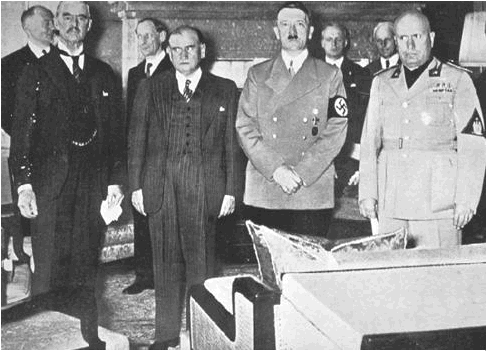
The central flaw in liberal foreign policy is its assumption that Vietnam was the principal lesson of the 20th Century. Wrong--it was 30 years before, the Adolph and Neville show that opened in Munich to good press, enjoyed a brief run in London, then closed in Berlin after an eight year run. Without America, eight years might have extended a thousand.

Since merging into a wholly owned subsidiary of the loony left, universities overlook that lesson. I wouldn't let 'um wash my car--never mind handing over the keys so they can drive America over a cliff.

(via Instapundit)

Don't Let Your Baby Be the Last Cowboy

I've never cared for cowboys, but the current Weekly Standard reviews Dayton Hyde's just-published memoir, The Pastures of Beyond: An Old Cowboy Looks Back at the Old West (subscription only for now). Hyde, now 80 years old, wrote 18 books about, and is a noted photographer of, the West. He's been a farmhand, rancher, rodeo performer horse trainer ever since, with time off only to invade Normandy with the Army Signal Corps. Hyde's essays are good, in part because his ilk is nearly extinct. As well as anyone, Hyde knows the cowboy dies with him:
Nowadays, with a normal human life span, an old cowboy like me will have said good-bye to about three of his favorite saddle horses or about five of his favorite cowdogs. One of the hardest things for a rodeo cowboy to accept is knowing that one day his body will give up. . . . Lord, be kind to this old cowboy. Don't send me to a land where there are no horses running wild and free, and no cattle to care for.
I'll report back after reading.

More:

I repent! There's still some good cowboys.

Kristol Clear

Weekly Standard editor Bill Kristol agrees censuring Dick Durbin isn't sufficient:
His comments are, to be sure, deserving of censure. But is this the best action to push for? For one thing, Democrats can explain that resolutions of censure have typically been reserved for ethics violations, not for meretricious statements--thereby perhaps succeeding in confusing the debate and wriggling off the hook. And asking for passage of such a resolution puts the burden on the Republican majority to act--which raises the possibility, maybe a probability, that the attempt will seem partisan if pursued, and if Republicans at some point back off, will then make them look weak as well.

Why not put the burden on the Democrats? When Sen. Trent Lott made a far less damaging, but still deplorable, statement two and a half years ago, his fellow Republicans insisted he step down as their leader. Shouldn't Democrats insist that Sen. Durbin step down as their whip, the number two man in their leadership? Shouldn't conservatives (and liberals) legitimately ask Democrats to hold their leader to account, especially given the precedent of Lott?
Damn right they should. But they won't--mostly because the press downplays Democrat disasters while foretelling the end of the republic with any Republican gaffe.

Clarity on Certainty

Three weeks ago, I recommended Charles Krauthammer's essay in the June 1st Time magazine. I've re-read it often, and have further thoughts.

Since the age of Reagan, the foreign policy debate swirls has several flavors (the taxonomy is inexact): Krauthammer is a big brain, as even adversaries such as Francis Fukuyama concede, and he's covered all those bases. His most interesting contribution stands on the shoulders of giants, particularly the "American exceptionalism" school praised here before. But he's best known for two essays a decade apart articulating an American "unipolarity":
In the winter of 1990-91, he wrote in Foreign Affairs of the "unipolar moment"; in the Winter 2002/03 issue of The National Interest, he expanded the scope of his thesis by arguing that "the unipolar moment has become the unipolar era." And in February 2004, he gave a speech at the annual dinner of the American Enterprise Institute in which he took his earlier themes and developed the ideas further, in the aftermath of the Iraq War. He defined four different schools of thought on foreign policy: isolationism, liberal internationalism, realism and his own position that he defines as "democratic globalism", a kind of muscular Wilsonianism-minus international institutions-that seeks to use U.S. military supremacy to support U.S. security interests and democracy simultaneously.
Obviously, Krauthammer's unipolarity touches both the power and multilateral prongs above. But, more controversially, Krauthammer returned to morals as well:
A large segment of American opinion doubts the legitimacy of unilateral American action but accepts quite readily actions undertaken by the "world community" acting in concert. Why it should matter to Americans that their actions get a Security Council nod from, say, Deng Xiaoping and the butchers of Tiananmen Square is beyond me. . .

This logic is deeply puzzling. How exactly does the Security Council confer moral authority on American action? The Security Council is a committee of great powers, heirs to the victors in the Second World War. They manage the world in their own interest. The Security Council is, on the very rare occasions when it actually works, realpolitik by committee. But by what logic is it a repository of international morality? How does the approval of France and Russia, acting clearly and rationally in pursuit of their own interests in Iraq (largely oil and investment), confer legitimacy on an invasion? . . .
Plainly, Krauthammer's detractors are the foreign policy cognate of academic post-modernists. According to leftist deconstrutionists, objectivity's impossible, everything's relative, so judgment's disputed or doomed. That alone explains the transformation of liberals to reactionaries. Once Foucault stole syllogism, change turned terrifying, locking the left into "just say no.". Now they say "Only Conservatives Deal in Absolutes." Their mantra comes from Camus, "We are not certain, we are never certain;" their prophet Nietzsche, who anticipated Fahrenheit 911 by a century, "Convictions are more dangerous enemies of truth than lies."

Krauthammer's Time magazine essay (mirrored here) explodes this nihilism. Caution and careful consideration are critical, but need not paralyze:
The campaign against certainty is merely the philosophical veneer for an attempt to politically marginalize and intellectually disenfranchise believers. Instead of arguing the merits of any issue, secularists are trying to win the argument by default on the grounds that the other side displays unhealthy certainty or, even worse, unseemly religiosity.

Why this panic about certainty and people who display it? It is not just, as conventional wisdom has it, that liberals think the last election was lost because of a bloc of benighted Evangelicals. It is because we are almost four years from 9/11 and four years of moral certainty, and firm belief is about all that secular liberalism can tolerate.

Do you remember 9/11? How you felt? The moral clarity of that day and the days thereafter?

A few years of that near papal certainty is more than any self-respecting intelligentsia can take. The overwhelmingly secular intellectuals are embarrassed that they once nodded in assent to Morrow-like certainty, an affront to their self-flattering pose as skeptics.

Enough. A new day, a new wave. Time again for nuance, doubt and the comforts of relativism. It is not just the restless search for novelty, the artist's Holy Grail. It is weariness with the responsibilities and the nightmares that come with clarity--and the demands that moral certainty make on us as individuals and as a nation.
At bottom, certainty is judgment about options producing choice. From Rawls to Roe, the left loves choice (well, except when they don't, e.g., involving Amendments 2, 5 (takings), and 10, plus alternate Tuesdays). Indeed they claim the Constitution contains both a right to certainty despite incomplete information and a ban on questioning even a child's judgment. Yet liberals favor freezing foreign policy while they "try to understand the grievances of the terrorists who flew into the World Trade Center," and call a 50 year-old University Provost with a doctorate an idiot, a dissembler and an outright liar--and impugned her judgment. If only she had lied about her age. . .

Certainty isn't inevitable, but it is the norm. The 9/11 hijackers were unambiguously evil; conservatives didn't condition certainty on the late game West-coast box scores. Starting 50 years ago, lefties targeted societal constraints -- in some cases properly so -- but, scrambling process and outcome, now reflexively reject rules because they're rules. But some now-discarded codes -- call them morals -- reflect 8,000 years of wisdom, shaped by circumstance over time, a transformation similar to English/American common law. Many Americans are certain about retaining that wisdom.

So persuade me; out hustle me; out vote me. But get a sophistication upgrade and junk "old code bad: it's old, certain and I'm impatient." And don't assume I'll subordinate my syllogism to your ADD. Sometimes, I'm certain about my judgment. I might be wrong -- ready, set, debate! -- but there's no one else’s judgment on which I can rely.

More:

Pedro grabs the ball and drives toward the goal-line.

Sunday, June 19, 2005

Just Say Nein

German Chancellor Gerhard Schröder's flying to Washington in late June, speaking to capitalists and begging Bush for a UN veto. It's likely Schröder's last state visit; he's unpopular and, after the September 18th election, joining 12 percent of Germans already unemployed.1

Schröder's Washington visit won't go unremarked, thanks to Ray D., co-author of Medienkritik -- the best English language blog about bias and anti-Americanism in Germany -- and Joe N. of ¡No Pasáran! -- the best bi-lingual French blog. Both are coming to DC, though not officially. Rather, they're Schröder's cheerleaders--Bronx cheers, says Ray:
We want to give him a warm sending-off, so...

...Live at 12:30 PM on June 27 at Lafayette Park directly across from the White House! Everyone is invited to attend...

A Demonstration against Anti-American Bias in German Media and Politics and for German-American Friendship and Cooperation.

[W]e are planning to have a stage with podium and microphone. Ray D. will be there live to discuss bias in the German media and to do blog readings. We will also supply signs and banners. We would like to ask readers for recommendations and suggestions for possible speakers and slogans.
Ray insists the rally isn't anti-German -- just anti-German media:
[A] very significant and highly influential portion of the German media is biased and does not fairly cover both the United States and conservative Americans. The fact is that the average consumer does not want to work very hard to find the rare voice that opposes the popular trend. Not only that, but much of the media continues to play to the lowest, populist common-denominator when it comes to Germans' feelings about Americans.
Count me in; it's only 5 blocks away. Look for me among the dozens holding a sign in one hand while live-blogging with the other.

(via NIF)
_____________

1 Schröder's ally French President Jacques Chirac diagnosed their mutual threat:
"facing sluggish economies, high unemployment and falling popularity, . . ..

Asked by a reporter whether the two leaders were united in pain, Chirac became animated.

"There is sort of a culture of pessimism in our countries," Chirac said. He contrasted France and Germany with the United States.
Unlike Schröder, however, Chirac gets 22 more government paychecks before qualifying for either the French dole (along with 1 in ten French workers) or Devil's Island prison wages after his prosecutorial immunity expires.


Details at David's Medienkritik

Have You no Sense of Decency, Sir, at Long Last?1

Moonbats will be Moonbats--normally safely ignored. Not so Senate Dems' #2 man--I share the widespread "outrage" and disgust over Senator Dick Durbin (D-Ill) drinking the "BusHitler" Kool Aid:
If I read this to you, and didn't tell you that it was an FBI agent, describing what Americans had done to prisoners in their control, you would most certainly believe this must have happened by Nazis, Soviets in their gulags, or some mad regime, Pol Pot or others, that had no concern for human beings. Sadly, that's not the case. This was the action of Americans in treatment of their own prisoners.
Durbin's historically ignorant if not inverted (or flunked it), reprehensible, an infantile embarrassment--the poster child for moral relativism. He's "treacherous", tunneling toward the terrorists' level, undercutting the war for political gain, giving aid and comfort to Islamofascists--a "huge propaganda gift to the enemy." Durbin's sleazy, a dissembling purveyor of propaganda and odious analogies, as John Podheretz said, "intellectually genocidal"--in sum, unfit for office.

Worse for Durbin, he's a fat target for Mark Steyn in today's Chicago Sun- Times:
The "atrocities" he enumerated -- "Not only was the temperature unbearably hot, but extremely loud rap music was being played in the room" -- are not characteristic of the Nazis, the Soviets or Pol Pot, and, at the end, the body count in Gitmo was a lot lower. That's to say, it was zero, which would have been counted a poor day's work in Auschwitz or Siberia or the killing fields of Cambodia. . .

Just for the record, some 15 million to 30 million Soviets died in the gulag; some 6 million Jews died in the Nazi camps; some 2 million Cambodians -- one third of the population -- died in the killing fields. Nobody's died in Gitmo, not even from having Christina Aguilera played to them excessively loudly. The comparison is deranged, and deeply insulting not just to the U.S. military but to the millions of relatives of those dead Russians, Jews and Cambodians, who, unlike Durbin, know what real atrocities are. Had Durbin said, "Why, these atrocities are so terrible you would almost believe it was an account of the activities of my distinguished colleague Robert C. Byrd's fellow Klansmen," that would have been a little closer to the ballpark but still way out.

One measure of a civilized society is that words mean something: "Soviet" and "Nazi" and "Pol Pot" cannot equate to Guantanamo unless you've become utterly unmoored from reality. Spot the odd one out: 1) mass starvation; 2) gas chambers; 3) mountains of skulls; 4) lousy infidel pop music turned up to full volume. One of these is not the same as the others, and Durbin doesn't have the excuse that he's some airhead celeb or an Ivy League professor. He's the second-ranking Democrat on the Senate Judiciary Committee. Don't they have an insanity clause? . . .

And this is where it's time to question Durbin's patriotism. As Leahy implicitly acknowledges, Guantanamo is about "image" and "perception" -- about how others see America. If this one small camp of a few hundred people has "drained the world's good will," whose fault is that? . . .

This isn't a Republican vs Democrat thing; it's about senior Democrats who are so over-invested in their hatred of a passing administration that they've signed on to the nuttiest slurs of the lunatic fringe. It would be heartening to think that Durbin will himself now be subjected to some serious torture. Not real torture, of course; I don't mean using Pol Pot techniques and playing the Celine Dion Christmas album really loud to him. But he should at least be made a little uncomfortable over what he's done -- in a time of war, make an inflammatory libel against his country's military that has no value whatsoever except to America's enemies. Shame on him, and shame on those fellow senators and Democrats who by their refusal to condemn him endorse his slander.
Censure won't do: Durbin should resign.

More:

Gary at Rightpundit quotes Sara's shorter summary.
__________________

1 McCarthy-Welch Exchange, June 9, 1954.

QOTW

Scripps Howard columnist Clifford May, republished at Defend Democracy:
France [is] a great nation that has been cursed with leaders who would rather France be a Great Power.