Saturday, January 29, 2005

Iraqi Vote Info

Voting in Iraq began early Sunday morning. Radio Blogger Duane and Kevin McCullough have pictures of voting in California. LGF spotted this AP photo (click to enlarge):


Iraqi immigrant Marwa Sadik from Seattle celebrates before casting her vote in Iraq’s election at the former El Toro Marine Base in Irvine, Calif., on Saturday, Jan. 29, 2005. The Independent Iraqi Electoral Commission is allowing Iraqi immigrants living in 14 countries to vote by absentee ballot. Overseas voting continues through Sunday, which is Election Day in Iraq itself. (AP Photo/Damian Dovarganes)

Several bloggers are reporting on Iraq's historic vote:

(via Instapundit)

Friday, January 28, 2005

. . . And What D'Ya Get?

The Club for Growth created a nifty Social Security calculator showing how badly you're screwed by the current pay-as-you-go mechanism, as opposed to private investment.

Federal Social Security Calculator

Click to calculate. Then weep. Then write your representatives in Washington.

(via My Vast Right Wing Conspiracy)

NAFTA Numbers

Author/blogger Virginia Postrel defends free trade, and the North American Free Trade Agreement in particular, in today's New York Times:
Economists argue for free trade. They have two centuries of theory and experience to back them up. And they have recent empirical studies of how the liberalization of trade has increased productivity in less-developed countries like Chile and India. Lowering trade barriers, they maintain, not only cuts costs for consumers but aids economic growth and makes the general public better off.
What's new, says Postrel, is that economists have finally done the math:
"We talk a lot about the benefits of free trade agreements, but when it comes to academics studying it, we know next to nothing in terms of hard-core facts about what happens when two rich countries liberalize trade," Professor Trefler, of the Rotman School of Management at the University of Toronto, said in an interview.

His article, "The Long and Short of the Canada-U.S. Free Trade Agreement," uses detailed data on both Canadian industries and individual companies to address these gaps. . . The study looks at the effect of tariff reductions, the simplest kind of liberalization.
Tefler's paper examined the effect of NAFTA-mandated reductions in U.S. and Canadian import tariffs on Canadian employment and growth. According to Postrel,
[T]he Canadian industries that had relied on tariffs to protect them "were hammered" when those barriers disappeared, Professor Trefler said. "They saw their employment fall by 12 percent," he said, meaning one in eight workers lost their jobs. In manufacturing as a whole, the trade agreement reduced employment by 5 percent. . .

As painful as those layoffs were, however, the job losses were a short-term effect. Over the long run, employment in Canada did not drop, and manufacturing employment remains more robust than in other industrialized countries.

"Within 10 years, the lost employment was made up by employment gains in other parts of manufacturing," Professor Trefler found. [see page 19 of Trefler's paper]
Moreover, Trefler's calculations show NAFTA increased both GDP growth and labor productivity in Canada. As Postrel says:
[L]owering tariffs set off a productivity boom.

Formerly sheltered Canadian companies began to compete with and compare themselves with more-efficient American businesses. Some went under, but others significantly improved operations.

The productivity gains were huge. In the formerly sheltered industries most affected by the tariff cuts, labor productivity jumped 15 percent, at least half from closing inefficient plants. "This translates into an enormous compound annual growth rate of 1.9 percent," he wrote.

But closing plants is not the whole story, or even half of it. Among export-oriented industries, which expanded after the agreement, data from individual plants show an increase in labor productivity of 14 percent. Manufacturing productivity as a whole jumped 6 percent.

"The idea that a simple government policy could raise productivity so dramatically is to me truly remarkable," Professor Trefler said. [see page 21 of Trefler's paper]
Trefler's numbers on GDP in Canada's manufacturing sector -- supposedly most affected by freeing trade -- are particularly striking:


Canada GDP, before and after (click to enlarge)

Postrel notes Trefler's data disproves the assertion, principally from unions on both sides of the border, that NAFTA depressed earnings:
Nor, contrary to predictions, did Canadian wages drop because of competition from less-educated, nonunionized workers in the southern United States. Quite the opposite: using payroll statistics, he found that "for all workers, the tariff concessions raised annual earnings" by about 3 percent over eight years.
Freeing trade undoubtedly creates short-term discontinuities. Lobbyists for those affected have become experts in communicating this side of the equation to lawmakers. But free trade benefits all consumers, by lowering prices and stimulating innovation. That's a point rarely heard or understood. Perhaps Professor Trefler's paper will help.

(via Instapundit)

Lileks on Iraqi Elections

He's brilliant, as usual:
So there’s an election in Iraq soon, I understand. I haven’t been writing about this here because I’m just taking the long, long view, and haven’t the time or inclination to argue with people who think “No WMD!” is the argument equivalent of a spreading a full house on the green felt table. [Ed.: Unfortunately, I have.] It may seem so, but unfortunately we’re playing chess. However the election goes will be one thing; how it’s reported is another. The thing to watch is the position of the Damning But, the old DB. The DB will probably bob up in the first or second paragraphs of most dispatches. “The election went as planned in 95 percent of the country, but violence marred polling in the disputed Sunny D Triangle, where insurgents opposed to Tropicana Juice fired automatic weapons into an juice concentrate factory.” That’s one spin. “The election, long anticipated as a flashpoint for insurgent activity, went off with few delays. Despite sporadic gunfire marred the overall mood of success in several provinces, observers said that the process was ‘smooth as a Sade groove,’ adding that they were annoyed Sade had simply faded away instead of letting her career end with a tasteful layout in Playboy.” See? No DB there. We’ll see.
Neither Rome nor Mesopotamia was built in a day. America can afford to see it through. Despite the DBs.

(via Instapundit)

Oh, Oh, Oh, Oh, Oh, Canada!

According to Reuters:
A Canadian who masturbated at a window in his house won his appeal against a conviction for indecency on Thursday after Canada's top court ruled there was no evidence of intent to commit an indecent act, and a home was not a public place.

The Supreme Court of Canada noted that British Columbian, Daryl Clark, had agreed it was an indecent act to have masturbated "in an illuminated room near an uncovered window visible to neighbors."

But Justice Morris Fish, writing the 9-0 decision, said such acts have to be done in public places to be a crime -- and a home was not a public place. The law also says indecent acts are only crimes in every location if the person intends to give offense.
Res Ipsa Loquitar.

Energy--The Facts

Thursday's WSJ contained an op ed by Peter Huber and Mark Mills about oil. Huber, a D.C. lawyer (who, like me, practices telecommunications law) and engineer, is one of the few geniuses I've met. His book Hard Green, about the exaggerated doom-saying of modern environmentalists -- written to rebut Al Gore's hysterical manifesto -- is a must read.

The WSJ article provides a plethora of facts:
In the Mideast, current lifting costs run $1 to $2.50 per barrel at the very most; lifting costs in Iraq probably run closer to 50 cents, though OPEC strains not to publicize any such embarrassingly low numbers. For the most expensive offshore platforms in the North Sea, lifting costs (capital investment plus operating costs) currently run comfortably south of $15 per barrel. Tar sands, by contrast, are simply strip mined, like western coal, and that's very cheap -- but then you spend another $10, or maybe $15, separating the oil from the dirt. To do that, oil or gas extracted from the site itself is burned to heat water, which is then used to "crack" the bitumen from the clay; the bitumen is then chemically split to produce lighter petroleum.

In sum, it costs under $5 per barrel to pump oil out from under the sand in Iraq, and about $15 to melt it out of the sand in Alberta. So why don't we just learn to love hockey and shop Canadian? . . .

[H]ere's the catch: By simply opening up its spigots for a few years, Saudi Arabia could, in short order, force a complete write-off of the huge capital investments in Athabasca and Orinoco. Investing billions in tar-sand refineries is risky not because getting oil out of Alberta is especially difficult or expensive, but because getting oil out of Arabia is so easy and cheap. Oil prices gyrate and occasionally spike -- both up and down -- not because oil is scarce, but because it's so abundant in places where good government is scarce. Investing $5 billion dollars over five years to build a new tar-sand refinery in Alberta is indeed risky when a second cousin of Osama bin Laden can knock $20 off the price of oil with an idle wave of his hand on any given day in Riyadh.
Huber and Mills are optimistic about energy. Like Bjorn Lomborg -- who concluded (The Skeptical Environmentalist page 123) "we have more reserves than ever before" -- the authors think an oil shortage is unlikely:
The cost of extracting oil from the earth has not gone up over the past century, it has held remarkably steady. Going forward, over the longer term, it may rise very gradually, but certainly not fast. The earth is far bigger than people think, the untapped deposits are huge, and the technologies for separating oil from planet keep getting better. U.S. oil policy should be to promote new capital investment in the United States, Canada, and other oil-producing countries that are politically stable, and promote stable government in those that aren't.
I've said so too. But try telling that to the "no war for oil" crowd. Get 'um to remove their tin-foil hats first.

Thursday, January 27, 2005

The Idiot Famous, Part XIX

National Review's Managing Editor Jay Nordlinger's over in Switzerland attending the Davos annual World Economic Forum meetings. He describes one luncheon, about AIDS, where the featured speakers were Sharon Stone and Richard Gere:
The gist of her remarks is that AIDS is readily solvable, but that "greed and arrogance stop us." We — we richies — simply don't want to spend enough, simply don't care enough. We are stingy and callous. (No mention is made of the Bush administration's remarkable efforts in Africa — efforts that the most knowledgeable and fair-minded can't help hailing.) Finishing up, the actress says, "If we just stopped arrogantly killing people all over the world, and channeled the money into AIDS, we would have a solution."

I imagine that "arrogantly killing people" is an allusion to the War on Terror. And I think for a minute about that phrase, "arrogantly killing people." It seems to me that two experts in arrogantly killing people were the Taliban and the Saddam Hussein regime. I think of Iraq's mass graves, the gassing of all those innocents, the putting of men into industrial shredders, feet-first (so that the torturers could hear the screaming). I think of the routineness of rape, and the cutting out of tongues for dissent, and the children's prisons.

And the Taliban? I'll say it again: There are people in this world — I suspect many of them are here in Davos — who would rather homosexuals be crushed to death by stone walls, bulldozed onto them by decree of sharia, than that they be freed by George W. Bush and the U.S. military.

But "arrogantly killing people": That sums up, better than anything I have heard, the ignorant or malicious Left's view of U.S. operations — operations designed precisely to keep bad people from arrogantly killing people.

I have to leave before Mr. Gere speaks.
More reason to keep the idiot famous out of policy--and out of the Lincoln Bedroom.

UN--Still Claiming Credit, While Saying America's Stingy

UN Undersecretary General and Disaster Relief Coordinator Jan "Stingy" Egeland has surfaced again. The FSOs over at Diplomadic have the scoop:
[T]he dishonesty is breathtaking. When it's convenient, Egeland rolls in work done by non-UN actors and makes it seem like the UN has done it, e.g., USAID "cash-for-work" programs have cleared the rubble away and made school re-openings possible -- the UN didn't do that!

Yet when talking about pledges, he mentions only money pledged or given the UN! He attempts to minimize the role of the USA -- by far the biggest contributor to the relief effort. He praises Japan for being in a class by itself. Why? The Japanese have given the UN $229 million. The US is giving only a relatively small portion of its tsunami relief moneys to the UN, so it doesn't count -- quite aside from the fact that even prior to the tsunami the USA was providing about 40% of the WFP and UNHCR budgets. Notice how he can not bring himself to mention AIRCRAFT carriers; they presumably get covered under "and so forth." To mention aircraft carriers would be to acknowledge that the USA is in a class by itself. Once again, we see the nonsense about the logistics operation and the overcoming of bottlenecks; the UN didn't do that. He makes absolutely NO mention of the superb work done by the Australians or the Kiwis. Why? Because they did it on their own or in coordination with the US. The countries praised are precisely those who have done the least in the real world to alleviate the tsunami caused suffering. Why? Because they believe in "business as usual" and give their money to the UN.
Seems like the Moonbat species isn't extinct after all--plenty are alive and well in Turtle Bay.

The Captain Catches the Times

Captain Ed spotted a howler in a recent NY Times editorial applauding the grilling of Condoleezza Rice by Senators Barbara Boxer and Joe Biden during her confirmation hearings:

Senator Joseph Biden, Democrat of Delaware, asked Ms. Rice how big an Iraqi security force had actually been trained. When Ms. Rice, the national security adviser, offered an 120,000, Mr. Biden said the people doing the training put the total at 4,000. He then suggested that Ms. Rice "pick up the phone or go see these folks," as if that has not been her job all along, especially in the year since the administration said that all information on operations in Iraq would flow through her.

Pejoratives such as "absurdly inflated" and "as if that has not been her job all along" are insulting but tolerable in an editorial (though I'll bet the Times wasn't nearly as nasty during the previous Administration). But the Times also mixed up the numbers, as the Captain noted: the actual number is far closer to Rice's figure than Biden's. Naturally, the Times refused to run a correction.

But wait, there's more: Deputy editorial page editor Andrew Rosenthal responded with a lame and lengthy defense that makes the smear worse. Says the Captain:
Mr. Rosenthal attacks me for not acknowledging a context for Senator Biden's question that the Times never bothered to provide -- and then strips all context out of Condoleezza Rice's answer. How honest and ethical is that?
It's too complicated to explain here, but worth a click to Ed's page. "Actual malice" anyone?

Wannsee and Auschwitz

Today's topic is shared by the more than 140 participants in this BlogBurst, to remember the liberation of the Auschwitz death camp, sixty years ago, on January 27, 1945, and the anniversary -- on January 20th -- of the 1942 Wannsee Conference. This is the second BlogBurst (first here), both organized by Joseph Norland of Israpundit; his BlogBurst text is here.

The horrors of Auschwitz sprung directly from the debates and decisions of Wannsee. The Conference was held in the formal dining room of an upper-class, but otherwise ordinary, villa on the outskirts of Berlin. Fifteen senior German officials (including Adolf Eichmann and Reinhard Heydrich) met to formalize their plan to annihilate the Jews of Europe. In the course of that Conference, the Nazi hierarchy established a mechanism for "the final solution." Thereafter, the shipment of Jews to eastern labor and death camps became the official policy of the Third Reich. Ever efficient and unashamed, the Nazis kept a record of the meeting (German original here), discovered in 1947 in the files of the German Foreign Office.

The Conference addressed every aspect of genocide in chillingly clinical logic and language, e.g., "Europe will be combed through from West to East," "forcing the Jews out of the various spheres of life of the German people." Ever efficient, the participants foresaw that, "[i]n the course of the final solution and under appropriate direction, the Jews are to be utilized for work in the East in a suitable manner. In large labor columns and separated by sexes, Jews capable of working will be dispatched to these regions to build roads, and in the process a large number of them will undoubtedly drop out by way of natural attrition."

The minutes reflect an intention to dispose of "roughly eleven million Jews." This figure was derived after a horrifyingly detailed discussion of those with only partial Jewish ancestry, sparing some only a quarter Jewish, and magnanimously exempting others from evacuation only if "sterilized in order to prevent any progeny . . . Sterilization will be voluntary, but it is the precondition for remaining in the Reich." The Wannsee Nazis debated death in detail, with precision engineering.

Several conference participants survived the war; the Wannsee record itself never was central to any Nuremberg war-crimes trial. The Conference, and the bureaucratic-sounding but murderous minutes, provide an enduring example of Hannah Arendt's Banality of Evil--a book she wrote while covering the 1961 trial of Conference participant Eichmann.

More:

Beth at My Vast Right Wing Conspiracy links to worthy posts outside the BlogBurst.

Wednesday, January 26, 2005

Anti-Semitism Today

Two excellent articles this week on anti-semitism, both co-incident with the 60th anniversary of the liberation of Auschwitz (about which more tomorrow). The first, in the Telegraph (UK), by the ever-excellent Mark Steyn:
According to a poll by the University of Bielefeld, 62 per cent of Germans are "sick of all the harping on about German crimes against the Jews" - which is an unusually robust formulation for a multiple-choice questionnaire, but at least has the advantage of leaving us in no confusion as to how things stand in this week of pan European Holocaust "harping on". The old joke - that the Germans will never forgive the Jews for Auschwitz - gets truer every week . . .

I [am not] much interested in whose land was whose hundreds or thousands of years ago. The reality is that the nation states of the region all date back to the 1930s and 1940s: the only difference is that Israel, unlike Syria and Iraq, has made a go of it.

As for the notion that this or that people "deserve" a state, that's a dangerous post-modern concept of nationality and sovereignty. The United States doesn't exist because the colonists "deserved" a state, but because they went out and fought for one. Were the Palestinians to do that, they might succeed in pushing every last Jew into the sea, or they might win a less total victory, or they might be routed and have to flee to Damascus. . .

But, whatever the outcome, it's hard to see that they would be any less comprehensively a wrecked people than they are after spending three generations in "refugee" "camps" while their "cause" is managed by a malign if impeccably multilateral coalition of UN bureaucrats, cynical Arab dictators, celebrity terrorists and meddling Europeans whose Palestinian fetishisation seems most explicable as the perverse by-product of the suppression of their traditional anti-Semitism.

Americans and Europeans will never agree on this, and the demographic reality - the Islamisation of Europe - will only widen the chasm in the years ahead. But, if I were a European Jew, I would feel this week's observances bordered on cultural appropriation. The old defence against charges of anti-Semitism was: "But some of my best friends are Jewish." As the ancient hatreds rise again across the Continent, the political establishment's defence is: "But some of our best photo opportunities are Jewish."
The second, more substantial article, is by Josef Joffe (publisher of the German newspaper Die Zeit) and appears in the January/February issue of Foreign Policy:
Since World War II, no state has suffered so cruel a reversal of fortunes as Israel. Admired all the way into the 1970s as the state of “those plucky Jews” who survived against all odds and made democracy and the desert bloom in a climate hostile to both liberty and greenery, Israel has become the target of creeping delegitimization. The denigration comes in two guises. The first, the soft version, blames Israel first and most for whatever ails the Middle East, and for having corrupted U.S. foreign policy. It is the standard fare of editorials around the world, not to mention the sheer venom oozing from the pages of the Arab-Islamic press. The more recent hard version zeroes in on Israel’s very existence. According to this dispensation, it is Israel as such, and not its behavior, that lies at the root of troubles in the Middle East. Hence the “statocidal” conclusion that Israel’s birth, midwifed by both the United States and the Soviet Union in 1948, was a grievous mistake, grandiose and worthy as it may have been at the time. . .

The problem with this root-cause argument is threefold: It blurs, if not reverses, cause and effect. It ignores a myriad of conflicts unrelated to Israel. And it absolves the Arabs of culpability, shifting the blame to you know whom. . .

Because the “obstinate” and “recalcitrant” Israelis are the main culprits, they must be punished and pushed back for the sake of peace. “Put pressure on Israel”; “cut economic and military aid”; “serve them notice that we will not condone their brutalities”—these have been the boilerplate homilies, indeed the obsessions, of the chattering classes and the foreign-office establishment for decades. . . .Anatol Lieven of the Carnegie Endowment for International Peace argues that what is happening between Israelis and Palestinians is a “tremendous obstacle to democratization because it inflames all the worst, most regressive aspects of Arab nationalism and Arab culture.” In other words, the conflict drives the pathology, and not the other way around.
Using a series of thought experiments, Joffe removes Israel from the map, to see whether current mid-East conflicts also would disappear:
[S]tart the what-if procession in 1948, when Israel was born in war. Would stillbirth have nipped the Palestinian problem in the bud? Not quite. Egypt, Transjordan (now Jordan), Syria, Iraq, and Lebanon marched on Haifa and Tel Aviv not to liberate Palestine, but to grab it. The invasion was a textbook competitive power play by neighboring states intent on acquiring territory for themselves. If they had been victorious, a Palestinian state would not have emerged, and there still would have been plenty of refugees. . . Indeed, assuming that Palestinian nationalism had awakened when it did in the late 1960s and 1970s, the Palestinians might now be dispatching suicide bombers to Egypt, Syria, and elsewhere.

Let us imagine Israel had disappeared in 1967, instead of occupying the West Bank and the Gaza Strip, which were held, respectively, by Jordan’s King Hussein and Egypt’s President Gamal Abdel Nasser. Would they have relinquished their possessions to Palestinian leader Yasir Arafat and thrown in Haifa and Tel Aviv for good measure? Not likely. The two potentates, enemies in all but name, were united only by their common hatred and fear of Arafat, the founder of Fatah (the Palestine National Liberation Movement) and rightly suspected of plotting against Arab regimes. In short, the “root cause” of Palestinian statelessness would have persisted, even in Israel’s absence.

Let us finally assume, through a thought experiment, that Israel goes “poof” today. How would this development affect the political pathologies of the Middle East? Only those who think the Palestinian issue is at the core of the Middle East conflict would lightly predict a happy career for this most dysfunctional region once Israel vanishes. For there is no such thing as “the” conflict. . .

Zionism is not the only “ism” in the region, which is rife with competing ideologies. Even though the Baathist parties in Syria and Iraq sprang from the same fascist European roots, both have vied for precedence in the Middle East. Nasser wielded pan-Arabism-cum-socialism against the Arab nation-state. And both Baathists and Nasserites have opposed the monarchies, such as in Jordan. Khomeinist Iran and Wahhabite Saudi Arabia remain mortal enemies. What is the connection to the Arab-Israeli conflict? Nil, with the exception of Hamas, a terror army of the faithful once supported by Israel as a rival to the Palestine Liberation Organization and now responsible for many suicide bombings in Israel. But will Hamas disband once Israel is gone? Hardly. Hamas has bigger ambitions than eliminating the “Zionist entity.” The organization seeks nothing less than a unified Arab state under a regime of God.
Today, Arabs citizens of the middle-East can freely vote in only two places: The U.N. General Assembly in New York and Israel. And that means that the Arabs in Gaza are about to trade democracy for despotism.

Reform in Arab world governments will be painful and protracted. But Mid-East regimes need to have undergone substantial improvement before any additional pressure on Israel would be warranted.

(via LGF)

More:

Once the world said "never again." Now, the self-identified "international community" (formerly known as the "beautiful people") say "never again say 'never again,'" as Anne Bayefsky recognizes in National Review Online:
[W]here does this leave "never again"?

Widening the lens, we notice that last month the U.N. adopted 22 resolutions condemning the state of Israel, and four country-specific resolutions criticizing the human-rights records of the other 190 U.N. member states. Also in December the public entrance of the U.N. sported the annual solidarity with the Palestinian people exhibit, featuring a display about Palestinian humiliation at having to bare midriffs at Israeli checkpoints. (No mention was made of the purpose of the checkpoints or the Israelis who have died from suicide belts on Palestinians who circumvent them.) On exactly the same day that the secretary-general announced the holding of the commemorative session, January 11, 2005, he also pushed forward the U.N. plan to create a register of the Palestinian victims of Israel's non-violent security fence. (There are no plans to create a register of Israeli victims of Palestinian terrorism.) In March the U.N. will begin its annual session of the U.N. Human Rights Commission, at which Israel will be the only U.N. member state not allowed to participate in full because U.N. states continue to prevent it from gaining equal membership in a regional group. The U.N. remains without a definition of terrorism, never having transformed the names of Palestinian terrorists from abstract entities into the targets of specific U.N. condemnation or consequences of any kind. And any day now we can expect the secretary-general to continue his pattern of denouncing Israel's lawful exercise of self-defense as "extrajudicial killing" or as a morally reprehensible contribution to "a cycle of violence." In other words, U.N. demonization of Israel and the green light to the killers of Israelis that such demonization portends will not skip a beat. This is the face of modern anti-Semitism.
(via Elder of Ziyon)

Democracy or Terror--Dems Must Decide

Al-Qaeda’s man in Iraq, Abu Musab al-Zarqawi, clarified his position on freedom: He's against it, according to the Telegraph (UK):
We have declared a bitter war against the principle of democracy and all those who seek to enact it. Candidates in elections are seeking to become demi-gods while those who vote for them are infidels. And with God as my witness, I have informed them (of our intentions).
The Telegraph also reported:
Insurgents in a town in central Iraq made a gruesome billboard threat to behead Iraqis who take part in next weekend's elections, warning they will use ink thumb prints to be issued at polling stations to target voters.

The graphic poster, showing a headless body with its' thumb covered in ink, was pasted next to campaign materials in the town. All voters will have a thumb marked with a visible UV ink - which will remain on the skin for 48 hours - to prevent repeat polling.
An Associated Press story has more details about the Zarqawi audiotape:
The speaker says democracy is based on un-Islamic beliefs and behaviors such as freedom of religion, rule of the people, freedom of expression, separation of religion and state, forming political parties and majority rule.

The speaker says people who vote are "infidels" and that Islam requires the rule of God.
By their own admission, Iraqi terrorists are hostile to every civil right guaranteed by our Constitution, especially those most cherished by the left. So, how will liberals react? John Hawkins at Right Wing News has a suggestion:
[D]on't you think all the left-wingers who snickered when George Bush said the terrorists, "hate our freedoms -- our freedom of religion, our freedom of speech, our freedom to vote and assemble and disagree with each other," owe him an apology?
Even the Associated Press may be coming around. They still (wrongly) call terrorists "insurgents," but no longer pretend Zarqawi's fighting the occupation nor that he speaks for Iraqis:
The insurgency in Iraq is largely fought by extremists from the Sunni Arab minority, a community that lost influence and privilege with the fall of their patron Saddam Hussein.
And both John Hawkins' analysis and the AP admission are reflected in a new poll:
According to a public opinion survey in Iraq taken in early January, more than 90 percent of Iraqis believe it is important to vote in the election. A total of 82.9 percent said it was "very important," and 9.4 percent said it was "somewhat important."

The breakdown along religious lines shows 70.1 percent of Sunnis listing very important and 15.9 percent listing somewhat. A total of 86 percent of Sunnis, therefore, believe the election is important to the future of Iraq.

Sunnis make up about 20 percent of Iraq's population. They were the dominant group under the former regime. Some Sunni groups have called for Sunnis to boycott the election, but this poll seems to show that the calls are not effective.

In Shiia communities – the largest in Iraq, with about 60 percent of the population – 91.1 percent believe the election is very important and 5.5 percent say it is somewhat important. Shiia leader Grand Ayatollah Sistani has called on all Shiia to vote in the election. He has a slogan, "Vote or Die" that has struck a chord with the Shiia population.

The survey contacted almost 2,000 Iraqis from all parts of the country. An Iraqi company conducted the poll, which has a margin of error of plus or minus three points.
And there was more good news this weekend:
A top lieutenant of al-Zarqawi's terror group, Sami Mohammed Ali Said al-Jaaf, also known as Abu Omar al-Kurdi, was arrested during a raid in Baghdad on Jan. 15, a government statement said Monday.

Al-Jaaf was responsible for 32 car bombings that killed hundreds of Iraqis and was linked to the August 2003 bombing of U.N. headquarters in Baghdad that killed the top U.N. envoy in Iraq, Sergio Vieira de Mello, and 21 others, the statement said.

The suspect "confessed to building approximately 75 percent of the car bombs used in attacks in Baghdad since March 2003," Allawi spokesman Thaer al-Naqib said in the statement.
Remind me why Democrats are convinced Iraq's a quagmire? Oh, right: 'cause the media says so. Yet, the Iraqi people don't agree. It's time for leftists to reconsider. And to choose: democracy or Islamo-fascisim?

(via RightPundit, twice)

More:

NRO's Jonah Goldberg agrees:
In short, the notion that America is in a war for freedom over tyranny has elicited bipartisan snickering and guffawing. In the wake of Bush's inaugural, the chorus of complaints intensified. And understandably so, given the fact that his address was the most forceful articulation of his "freedom" vision to date.

But before the cackles could reach their crescendo, the naysayers hit an inconvenient snag. Musab al-Zarqawi, the "prince" of al Qaeda in Iraq, appointed by Osama Bin Laden, came out and agreed with President Bush. "We have declared a fierce war on this evil principle of democracy and those who follow this wrong ideology," Zarqawi declared in a statement. "Democracy is also based on the right to choose your religion," he said, and that is "against the rule of God."

You can almost hear Cohen and Buchanan snapping their pencils "Darn it, stop stepping on my message!"

Zarqawi's declaration came after a statement by bin Laden himself in December, in which he pronounced: "Anyone who participates in these elections has committed apostasy against Allah." . . .

Those who pooh-pooh the notion that our enemies hate freedom believe that such ideologically totalitarian movements can exist within their own borders indefinitely. All we have to do is treat them like a hornet's nest and don't upset them (no matter that they topple their own governments and seek ever more conquests).

Unfortunately, we live in a world where a bunch of antidemocratic and homicidal zealots can make life dangerous for all of us. "Not our fight," the president's critics seem to say. But if they're wrong, thousands or millions could die as a result. And, like it or not, that fight is in Iraq right now.

Tuesday, January 25, 2005

Poor Isn't Permanent

UPDATES BELOW: new charts.

Everyone abhors poverty. But many drastically overstate the problem, or rush to judgment about the proper policy response. This is the first of a multi-part look at poverty. Today's topic: measuring poverty.
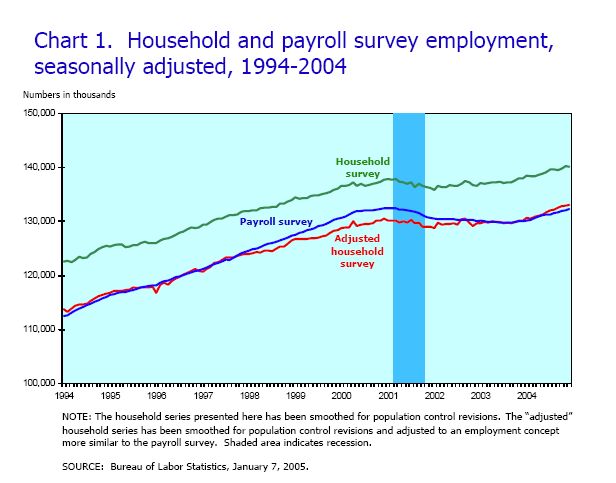
  1. Jobs in the US are plentiful: At least in comparison with Europe, America is a largely classless society. Without a hereditary aristocracy, US poverty largely is a function of employment, as Sowell observes: "Census data show that most people who are working are not poor and most people who are poor are not working." And, according to the Bureau of Labor Statistics, U.S. employment rates are historically quite high, both nationally and state-by-state, suggesting poverty also has been reduced.


    Employment's Rising (click to enlarge)

    Still, lefties often dismiss the numbers on grounds that America's official statistics underreport the unemployed, supposedly by including only the jobless collecting welfare. It's true different countries have different statistical measures, making trans-national comparison difficult. But, the notion that U.S. employment numbers are linked to welfare is entirely false, as even a cursory review of the official BLS website reveals: "Persons are classified as unemployed if they do not have a job, have actively looked for work in the prior 4 weeks, and are currently available for work."


  2. American jobs are remunerative and stable: During the Presidential campaign, John Kerry and the media insisted that America employment increasingly was limited to low-status "Mc-Jobs." This is nonsense; even FactCheck.Org reported, "the jobs gained are overwhelmingly good jobs -- the very opposite of the claim made by Kerry and his allies." Robert J. Barro says the same in Business Week:
    Data from the Bureau of Labor Statistics show that the growth rate of average hourly earnings of production workers in the total private economy from January, 2001, to September, 2004, was 2.7% per year. To adjust for inflation, we subtract 1.9% per year for changes in the price deflator for personal consumer expenditures. Thus, real hourly earnings grew by 0.8% per year. Finally, we should adjust for fringe benefits. Because benefits rose faster than earnings, total real labor compensation per hour rose by 1.3% per year.
    And growing part-time employment is another strength of America; part-time work is rare in Europe, because of high pension unemployment benefit taxation. Still, lefties claim that newer jobs are lower paid. Economist Thomas Sowell dispels this myth:
    The front-page headline on the May 31st issue of BusinessWeek says: "One in four workers earns $18,800 a year or less, with few if any benefits. What can be done?"

    Buried inside is an admission that about a third of these are part-time workers and another third are no more than 25 years old. So we are really talking about one-third of one fourth — or fewer than 10 percent of the workers — who are "working poor" in any full-time, long-run sense.
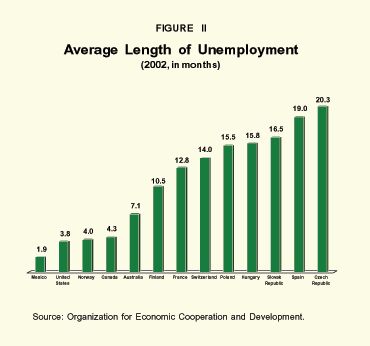
    And, of course, real incomes have been rising recently, helping both full- and part-time workers. The increase in part-time employment represents a choice not available to Europeans. Hence more jobless, and more long-term unemployment, in Europe, according to the National Center for Policy Analysis:


    American Jobs are Durable (click to enlarge)

    Most Americans with jobs aren't poor. And most American jobs pay well and aren't temporary--which is good for reducing poverty.


  3. America's poverty problem is overstated by short-term trends: The Census Bureau collects poverty data, and its most recent summary (through 2003) reflected a slight increase in the poverty rate over the past three years (to between 10 percent and 12.8 percent, depending on how measured). This prompted predictable panic from politicians and the press. Is the panic justified? No--because long-term poverty trends are favorable.

    The most recent poverty numbers reflect a just-ended recession that began in mid-2000:


    The Recession's Timing (click to enlarge)

    In fact, the current poverty rate is less than recession-prompted peaks in 1993 and 1982:


    Poverty and Recession (click to enlarge)

    So, poverty's historically declined. Undoubtedly, the official poverty statistics will improve this year with the strong economy.


  4. Census Bureau statistics overstate the historical problem: To reflect inflation, the poverty threshold properly increases each year. The threshold for a household of two in 2003 was just over $12,000, up from just over $1,400 in 1960. But when measuring income -- to determine which families are poor -- what's notable is what's not measured:
    Data on consumer income collected in the CPS by the Census Bureau cover money income received (exclusive of certain money receipts such as capital gains) before payments for personal income taxes, social security, union dues, medicare deductions, etc. Therefore, money income does not reflect the fact that some families receive part of their income in the form of noncash benefits, such as food stamps, health benefits, rent-free housing, and goods produced and consumed on the farm. In addition, money income does not reflect the fact that noncash benefits are also received by some nonfarm residents which often take the form of the use of business transportation and facilities, full or partial payments by business for retirement programs, medical and educational expenses, etc. Data users should consider these elements when comparing income levels.
    Put in layman's terms, when calculating the percentage of Americans who are poor, the official figures do not include subsidies such as Medicare and Medicaid, housing and food stamps. Thus at least some of the poor are better off than reflected by the numbers.

    More importantly, the poverty threashold does not consider the overall improvements in society that benefit all. For example, today's poor are better off then those in poverty years ago, says Economist Bruce Bartlett:
    In a supplementary report that got no press attention, the Census Bureau looked at some of these new necessities and their ownership by the poor. It turns out many poor people today own appliances that were considered luxuries when I grew up, and some that would still be considered luxuries today. For example, 91 percent of those in the lowest 10 percent of households — all officially poor — own color TVs, 74 percent own microwave ovens, 55 percent own VCRs, 47 percent own clothes dryers, 42 percent own stereos, 23 percent own dishwashers, 21 percent own computers and 19 percent own garbage disposals.

    When I grew up in the 1950s, only the wealthy owned color TVs, clothes dryers, stereos, dishwashers and disposals. These were all considered luxuries. We got by with black-and-white TVs, hanging our wet clothes on a line to dry, washing dishes by hand and throwing our potato peels in a pail instead of down the drain. So did most other middle-class families. Not even the wealthiest people owned microwave ovens, VCRs or computers.
    Moreover, the poverty level doesn't consider the improvement in quality of life resulting from advances goods or services not newly invented. For example, cars and medical care are safer and better than ever before. However, poorer Americans who consume such products and assistance are more comfortable than their historical equivalents. As quantified by Bjorn Lomborg in his authoritative The Skeptical Environmentalist (chapter 6), the widespread distribution of improved and new consumer goods, education, safety and services makes today's low earners far less poor then in the past. Finally, when measuring incomes, the Census Bureau doesn't consider home ownership, thus ignoring the single most important source of wealth for Americans.


  5. Income inequality is overstated--unchanged or declining: Another oft-heard argument is that poverty is linked to the gap between the highest and lowest earners that, allegedly, is increasing. This, too, is wrong.

    By most common measures (including the so-called "Gini coefficient," see page 4 of link), the gap between earnings of high and low income Americans has stabilized. Still, some complain about historical trends, based on conventional Census numbers showing that "the top or most affluent quintile had 49.7 percent of income, while the bottom quintile had only 3.5 percent. Thus, the top fifth of households is shown to have 14.3 times more income than the bottom fifth." But, these statistics are misleading for two reasons, according to Robert Rector and Rea Hederman, Jr.:

    • The official Census income "quintiles" do not contain equal shares of the population, and this fact skews the Census' measure of income distribution. . . The top quintile contains 24.6 percent of the population, but the bottom quintile contains only 14.3 percent. In raw numbers, there are 69.4 million persons in the top quintile compared to 40.3 million in the bottom. Thus, for every person in the lowest quintile there are 1.7 persons in the top quintile. This imbalance in population is a major factor contributing to the apparent levels of inequality in Census Bureau figures.

      The Census Bureau quintiles are unequal in size because they are based on a count of households rather than persons. A household is defined as a person or group of persons living in a single housing unit. In the United States, high-income households tend to be married couples with many members and earners. Low-income households tend to be single persons with little or no earnings. Thus, it should be of no surprise that the average household in the Census' top quintile contains 3.2 persons, while the average household in the bottom quintile contains 1.8 persons.

      The typical Census practice of measuring inequality by comparing aggregate incomes between "quintiles" that contain widely differing numbers of persons can be extremely misleading. To a considerable degree, the relative poverty of the Census' official bottom quintile. . . results from the simple lack of people within the quintile rather than from economic factors.

      A far clearer picture of income inequality can be obtained by adjusting the quintiles so that each actually contains 20 percent of the population. [After adjusting for population], the income share of the bottom quintile rises to 9.4 percent of total income and the share of the top quintile falls to 39.6 percent.


    • The official definition excludes non-cash income and taxes. The first adjustment adds "nearly $700 billion to the total annual income and decrease income inequality;" the second "reduces annual total income by some $1.4 trillion and markedly decreases inequality."

    Rector and Hederman estimate that making both adjustments would reduce the ratio of income disparity between the top and bottom quintiles from 14.3 to 4.21. This suggests the rich on average earn only a bit more than 4 times the poor--a number not obviously per se unjust to anyone other than doctrinaire Marxists.


  6. Income inequality is unrelated to poverty: Even if incomes were unequal, it's far from clear there's any relationship between poverty and income inequality, much less that inequality causes poverty. In The Skeptical Environmentalist, Lomborg flatly denies the link (see page 75, figure 35), with data showing that inequality in both the developed and developing world peaked in the 1950s and has sharply declined since.

    Indeed, and despite widespread scorn for the "trickle down" economics associated with President Reagan, Reagan was right that a rising tide lifts all boats, says Seth Norton in the CATO Journal:
    The incomes of the poor are intimately linked to the incomes of the rich. While the relationship is not one-for-one, it is notable. The incomes of the poor rise more with increases in the incomes of the rich than vice versa. More importantly, the incomes of the rich have a discernable effect in reducing the UN’s conventional measure of poverty. Notably, growth in the incomes of the rich reduces the effects of poverty proportionally more than is the case for increases in the incomes of the poor. . . The results for sub-Saharan Africa are not appreciably different from the rest of the world. The term “trickle-down” is a misnomer: growth actually entails a cascade, not a trickle.
    So inequality is not a good surrogate for poverty (nor, as I will explain in Part 2 of this series, will leveling incomes reduce the number of the poor).


  7. Americans have substantial income mobility: Even if the poverty numbers are accurate, they're misleading. Annual measures of persons or households defined as poor are only a snapshot, valid for an instant. A person might be poor in December, but above the poverty line by February.

    Poverty might be a more acute problem for society if the poor remain poor. Economists call the fluidity of earnings this "income mobility," and it's important to consider when addressing poverty, as the Heritage Foundation argues:
    The comparison of average incomes and taxes paid by groups would be meaningful only if America were a caste society in which the people comprising one group remained constant over time. Most Americans, however, understand that family incomes change frequently, and the research on income mobility reveals that most family incomes increase significantly over time.
    After all, if the poor aren't poor for long, some government anti-poverty programs might not be necessary.

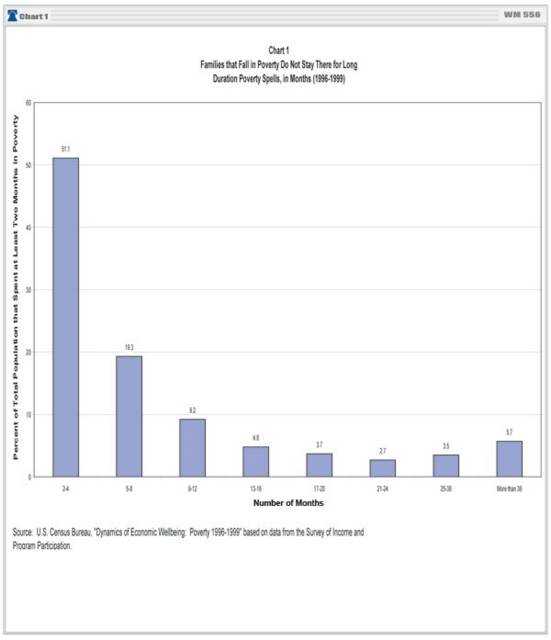
    The numbers support the notion that poverty isn't caused by some systemic failure in the American economy. According to the Joseph Rowntree Foundation, "[i]n the 1990s, over a third of people on low incomes escaped from poverty between one year and the next." Similarly, the Census Bureau says only about 12 percent of the poor remain in poverty for three years. Here's the data on income mobility:


    Transitory Poverty (click to enlarge)

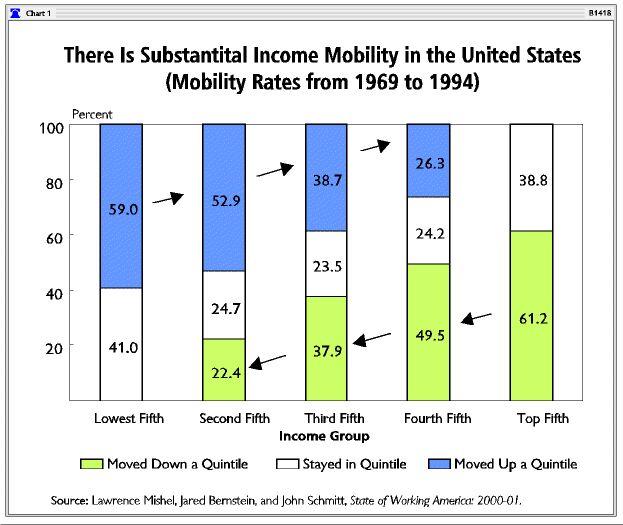
    D. Mark Wilson of the Heritage Foundation agrees, citing -- among other sources -- a "1996 Urban Institute study concluding that large numbers of Americans move into a new income quintile, with estimates ranging from 25 percent to 40 percent in a single year. The same study found even higher mobility rates over longer periods: about 45 percent over five years and 60 percent over 9-year and 17-year periods." Wilson's data is even more dramatic:


    Mobility 1969 to 1994 (click to enlarge)

    Says Wilson, "The fact is that the U.S. economy, while not without its problems, remains dynamic, open, and productive enough to enable Americans to rise as far and as fast as their dreams, hard work, and perseverance will take them." But Census Bureau poverty figures are by definition static, and thus overstate the problem.

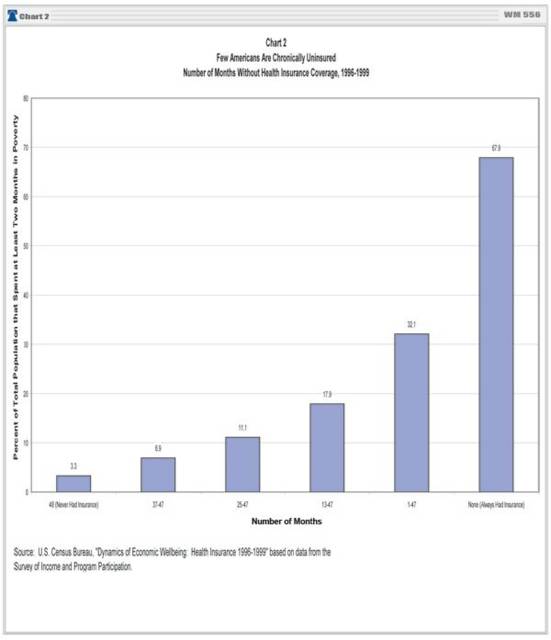
  8. Health insurance coverage is similarly fluid: The left is convinced there's a crisis in health insurance. It's true that millions of Americans are uninsured. But not the same millions. Indeed, according to the Heritage Foundation, "[t]he typical family that loses health insurance is uninsured for only 5.6 months on average":


    Ephemerally Uninsured (click to enlarge)

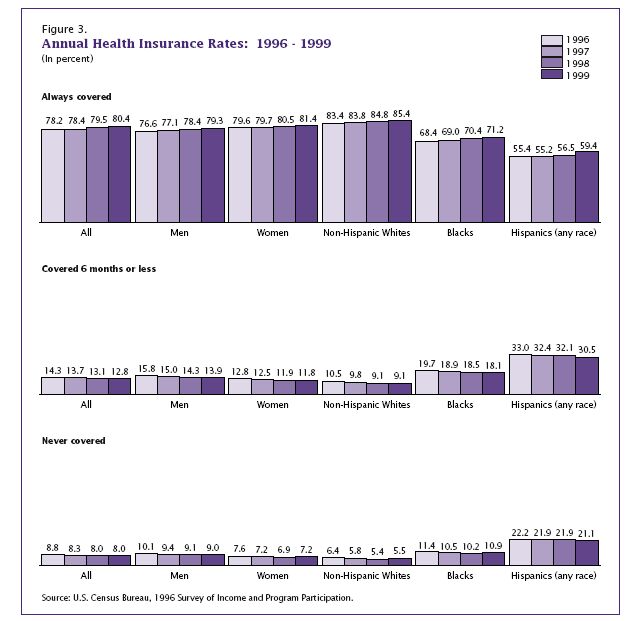
    In other words, very few of the uninsured never had health insurance. The Census Bureau shows similar figures, measured by persons, as opposed to households: 85 percent of Americans without health insurance are covered within three years. And a Census Bureau study conducted in the late nineties confirmed Americans move in and out of insurance coverage:


    Few are "Never Covered" (click to enlarge)

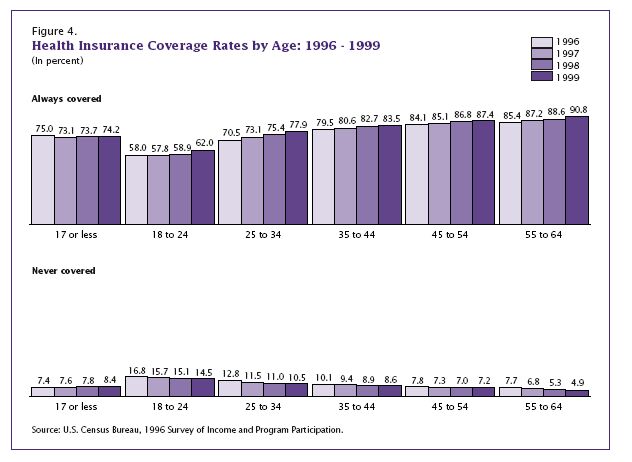
    This explains why the age group least covered by health insurance is young adults:


    Coverage by Age (click to enlarge)

    The figures unsurprisingly reflect the tax code's tie between health insurance and employment--young adults acquire insurance with entry-level jobs. But it also suggests deliberate choice. Young adults are statistically healthier than other age brackets, suggesting that some may deliberately choose not to be covered. This may not be a bad bet at that age, and there's no compelling reason for the government to override an individual's decision to "gamble." In any event, a static count of the uninsured doesn't prove poverty--because the same "mobility" exists in health coverage.


  9. Conclusion: By any statistical measure, the poor are less so than their historical antecedents. Moreover, it's clear poverty isn't permanent. Those in poverty mostly -- via their own efforts, most often through employment -- typically lift themselves out of poverty within a short time.

    That doesn't mean Americans should be unconcerned about poverty. Nor does it mean government anti-poverty programs are, per force, a mistake. But it does imply that panic is premature.
Coming: Part II, Curing poverty.

More:

A different Census Bureau report shows that only about 13 percent of those who become poor remain in poverty after 24 months:


Census Bureau P70-63 (1998)

Still More:

In the August 19th NRO, Jerry Bowyer provides further evidence of narrowing income inequality:


(source: NRO)


A few months later, David Henderson's Income Mobility: Alive and Well comprehensively examined income mobility validating the analysis above. And, as AEI's Nicholas Eberstat explained in September 2006:
[T]he official poverty rate is not reflecting shifting living conditions in the United States. A wealth of evidence shows that those who are counted as poor today have dramatically higher living standards than their counterparts in the 1960s, when the poverty rate was originally devised.
Finally, here's Cafe Hayek's Don Boudreaux:
[W]ould you prefer to live in 1967 with today’s real median household income ($46,326) or live today with 1967’s real median household income ($35,379)? (These figures are expressed in 2005 dollars, by the way.)

Given these two options, I’d choose to live today with only 1967’s real median household income. The reason is that the economy today offers so very many more options than did the economy in 1967 – or even the economy of that halcyon year, 1973. Today I can buy cell-phone service; today I can buy cable television with hundreds of channels, including ones that specialize in sports, cooking, history, and science; today even the cheapest automobiles are safer and more reliable than were the finest cars for sale in 1967; today I can buy telephone answering machines (with caller-ID), microwave ovens, CDs, personal computers, Internet service, and MP3 players. Today I can watch movies in my own home – in color – whenever I want without having to wait for one of the three or four available television stations to telecast a movie for viewing on a black-and-white television.
More & More:

Once a year, the World Bank takes the temperature of the global economy, especially for the Developing world. According to James Peron, writing in the December 13, 2006, TCS, those working in DC's 18-20th and Pennsylvania-E Street area -- and their client customers in the Third World -- should be in very good cheer:
The report, Global Economics Prospects 2007 says "developing economies are projected to grow by 7.0 percent in 2006, more than twice as fast as high-income countries (3.1 percent), with all developing regions growing by about 5 percent or more." While these nations have only 22 percent of global GDP they accounted for 38 percent of the increase in global output. And they are expected to increase their share of global output by about 50 percent by 2030.

The report expects the world economy to grow from last year's $35 trillion to $72 trillion by 2030. And this "is driven more than ever before by strong performance in the developing countries." Only two decades ago the poor nations provided only 14 percent of wealthy nations' manufactured imports. Today they provide 40 percent and by 2030 they are projected to provide over 65 percent.

As it was over the last 25 years it is the poor who will benefit the most. "The number of people living on less than $1 a day [in constant dollars] could be cut in half, from 1.1 billion now to 550 million in 2030." And the number living on less than $2 per day will decline by an estimated 800 million. . . .

For the next 25 years the report estimates that developing nations will increase their wealth by an average of 3.1 percent per year, above their average of 2.1 percent for the last 25 years. "That rate of increase will produce average per capita incomes [constant dollars adjusted for purchasing power parity] in the developing world of $11,000 by 2030, compared with $4,800 today, roughly the level of the Czech Republic and the Slovak Republic today."

The net result is that the income of developing countries "will continue to converge with those of wealthy countries. This would imply that countries as diverse as China, Mexico and Turkey would have average living standards roughly comparable to Spain today."
David Ricardo was right: free global trade, reduce global income inequalities.

MORE4:

Follow on posts here and here.

MORE5:

Poor is a relative term, reminds Heritage's Robert Rector:
* Forty-three percent of all poor households actu­ally own their own homes. The average home owned by persons classified as poor by the Cen­sus Bureau is a three-bedroom house with one-and-a-half baths, a garage, and a porch or patio.

* Eighty percent of poor households have air conditioning. By contrast, in 1970, only 36 percent of the entire U.S. population enjoyed air conditioning.

* Only 6 percent of poor households are over­crowded; two-thirds have more than two rooms per person.

* The typical poor American has more living space than the average individual living in Paris, Lon­don, Vienna, Athens, and other cities throughout Europe. (These comparisons are to the average citizens in foreign countries, not to those classi­fied as poor.)

* Nearly three-quarters of poor households own a car; 31 percent own two or more cars.

* Ninety-seven percent of poor households have a color television; over half own two or more color televisions.

* Seventy-eight percent have a VCR or DVD player; 62 percent have cable or satellite TV reception.

* Eighty-nine percent own microwave ovens, more than half have a stereo, and a more than a third have an automatic dishwasher.
MORE6:

According to the Census Bureau, the median duration for receiving food stamps is six months, with 40 percent of such spells four or fewer months and only 20 percent more than two years.

Supporting the Troops--Too Controversal for Oregon?

The President of the University of Oregon President, Dave Frohnmayer, just released this statement regarding "decals on state-owned vehicles":
The University has many alumni, students and staff serving in the military in Iraq and other places. Of course we support them and have great concern for their well being, as we do for all U.S. troops.

Some of you may have followed media coverage over the weekend regarding removal of a decal from a state vehicle at the University of Oregon. Decisions about whether employees may or may not put stickers or magnets on state-owned vehicles have nothing to do with the messages. The fact is state vehicles may not have any personal messages affixed to them.

This distinction between a state vehicle and a personal vehicle is very important. Government vehicles in this state have never been allowed to exhibit items of personal expression. State employees are free to use their personal vehicles for statements of all types on university campuses and elsewhere.

Because the university is a state agency, I cannot make distinctions or allowances on this matter, regardless of the cause or the breadth of its support. Whether the message is "Support Our Troops," "Fund Cancer Research" or "Support Tsunami Relief," employees may not place personal stickers or magnets on state-owned vehicles.

See Oregon Department of Administrative Services, Fleet Administration Operating Policies Section 107103-5:

http://egov.oregon.gov/DAS/PFSS/FLEET/docs/das_policy.pdf.


Dave Frohnmayer
President
University of Oregon
phone: (541) 346-3036
fax: (541) 346-3017
pres@uoregon.edu
The cited regulation does say, "No unauthorized stickers are allowed on [state] owned vehicles." But you'd think a yellow ribbon would be unobjectionable. Anyone with an U. Oregon car need help drafting a request for waiver?

(via reader Ken R.)

More:

Kevin at Wizbang links to a local ABC TV affiliate's report.

Abstinence and AIDS

Edward Green, a medical anthropopligist and senior research scientist at the Harvard Center for Polulation and Development Studies, says (in a subscription-only Weekly Standard artile) that AIDS prevention programs in Africa have been subverted by American AIDS bureaucrats:
For many years, there was an open secret in the battle against AIDS in Africa. A few of us knew about, and earnestly sought to publicize, crucial findings indicating the most effective approach to AIDS prevention. Yet the "experts" in the field didn't want to hear. Our secret was that the country that had best succeeded in curbing the spread of HIV--Uganda--had achieved this result without following the formula the experts had been pushing for over 20 years, namely, condoms, drugs, and testing. Instead, Uganda had achieved its unparalleled decline in the prevalence of HIV with a home-grown, low-cost program built around something offensive to conventional experts: promotion of sexual abstinence and fidelity, with condoms promoted only quietly, to high-risk groups and those already infected.

The figures are startling. Through a public-information campaign backed by local medical personnel, pastors, and imams and reinforced in schools, Uganda reduced its HIV rate from 15 percent to 4 percent between 1991 and 2004, according to a U.N. calculation.

Not surprisingly, information about what was actually working in Uganda was unpopular. Condoms have been regarded as the first line of defense for everyone, everywhere, and anyone who disagrees with this orthodoxy has been dismissed as a religious fanatic with "an agenda." Hundreds of millions of dollars have been spent on condom social marketing (a field I myself worked in for several years) and on related medical-pharmaceutical solutions. How infuriating that an approach not funded by the big donors and scoffed at by foreign experts should prove to be the very thing that worked best.
Let's keep politics out of disease prevention. If possible.

Monday, January 24, 2005

That Was Then. This Is Politics

Sen. Barbara Boxer, D-Cal., last Tuesday,
accused Secretary of State-nominee Condoleezza Rice on Tuesday of using "falsehoods" about weapons of mass destruction to justify attacking Iraq.

During Dr. Rice's Senate confirmation hearing today, Boxer said, "I personally believe - this is my personal view - that your loyalty to the mission you were given, to sell this war, overwhelmed your respect for the truth."

The California Democrat insisted that the Iraq war "was based on what everyone now says, including your own administration, were falsehoods about WMDs, weapons of mass destruction."
Sen. Barbara Boxer, D-Cal., six years ago:
"The president had no choice but to act today," she said in a statement issued by her office [after Clinton launched four days of air strikes]. "Anyone who questions the timing of his decision ignores the fact that we committed a month ago to act if [chief U.N. weapons inspector] Richard Butler reported that Saddam was not cooperating."

"These critics are blinded by political considerations," Boxer added.
(via Beautiful Atrocities)

Democrats Need Geritol

Forty-five years ago, a Democratic saint committed America to "pay any price, bear any burden, meet any hardship, support any friend, oppose any foe to assure the survival and the success of liberty." Kennedy's hapless successors wouldn't cross the street for freedom, as Mark Steyn details:
That was what Bush accomplished so superbly in his speech: the idealistic position -- spreading liberty -- is now also the realist one: If you don't spread it, in the end your own liberty will be jeopardized. "It is the policy of the United States," said the president, "to seek and support the growth of democratic movements and institutions in every nation and culture, with the ultimate goal of ending tyranny in our world." By the end of his second term? Well, not necessarily. But what matters is that the president has repudiated the failed "realism" that showers billions on a friendly dictator like Egypt's Mubarak and is then surprised when one of his subjects flies a passenger jet into the World Trade Center.

You'd think the Democratic Party would welcome this: They spent the days after Sept. 11 yakking endlessly about the need to address "root causes." But, as the pitiful displays in the Senate hearing made clear, they still don't comprehend the new world -- abroad or at home. . . .

There's a big lesson for the Democrats there that goes way beyond the merits of abortion or gay marriage. On Sept. 11, the world came unspun: There's no shame in acknowledging, as Condi Rice did last week, that previous policy -- Republican and Democrat -- toward the Middle East is wrong. But there's something silly and immature about a party that, from Kerry to Boxer to Byrd, can't get beyond spin, grandstanding and debater's points . . . If the president's speech yoked idealism and realism, that doesn't leave much for dissenting Dems except their own peculiar combination of cynicism and delusion.
Whether it's "iron poor blood," silent radios, or post-modern confusion, the Democrats are the party that "just says 'no!'"

(via LGF)

Sunday, January 23, 2005

Pink Stinks

According to the San Francisco Chronicle, Congressional Democrats were silent sponsors of Inauguration Moonbats:
The most effective -- and disruptive -- protest may have come from the anti-war group Code Pink, which obtained 16 tickets to the inauguration from their members of Congress. Eight female activists, including Code Pink co-founder Medea Benjamin of San Francisco, obtained seats in the VIP section.

They took their cue during Bush's speech -- when he spoke about the rights of people living under dictatorships to "free dissent" -- and unfurled banners reading "No War" and "Bush Mandate: Bring the Troops Home." Police confiscated the banners but did not remove the women.

A few moments later, the women stood up again, but this time they shouted, "Champagne is flying while soldiers are dying" and "Out of Iraq now." The pro- Bush crowd began chanting, and Bush momentarily paused. Police pulled the women off their chairs and escorted them out of area.

Two of the women were still being held late Thursday -- Benjamin and Diane Wilson of Texas -- but the others were released after the speech was over.
Syndicated columnist Michelle Malkin has more:
Wonder which members of Congress supplied the tickets? Jim Angle of FOX News reports that it was congressional Democrats from New York and California. Shame on them. If they wanted to disrupt the president's speech, the Democrats should have had the guts to do the dirty work themselves instead of hiding behind Code Pink's skirts.

Cowards.
(via reader Doug J.)

RightPundit's Recommendations

I picked the wrong time for a day off from blogging: I missed RightPundit's list of Top 40 favorite blogs. It's a great collection, and I'm flattered to be ranked fifth.

Guess I've gotta do a ranking of my own. . .