Apparently, bloggers have bad taste in Sci-Fi movies. (My list includes only the current numbers 2 4 and 10.)
(via Speed of Thought)
Saturday, June 04, 2005


Friday, June 03, 2005
First (Stolen) Headline Contest
I've shamelessly swiped this from Kathryn Lopez at NRO; it's too tempting to ignore. The contest asks readers to enter in comments their best headline for the following story (quoted here only in part):
Nine French fighter jets and a radar plane stayed overnight at Atlantic City International Airport after bad weather prevented them from returning to their aircraft carrier off the Virginia coast, authorities said Friday.Read it all. Contest closes Monday afternoon.
The planes, low on fuel, initially asked for permission to land Thursday at a United States military installation but lacked the clearance number, said Noel Clay, a spokesman for the U.S. State Department.
The planes, which had been conducting military exercises, then sought and received permission for emergency landings at the airport here around 3:45 p.m.
Half a Loaf
On April 26th, the French Court of Appeals in Versailles ruled against the establishment French Newspaper Le Monde, condemning the paper for "diffamation raciale" (racist slander) in connection with a June 4, 2002, op-ed called "Israel-Palestine: The Cancer." In particular, the court convicted the article's lead author, well known sociologist Edgar Morin,1 his two co-authors, and Jean-Marie Colombani, Le Monde's publisher.
In particular, the Court pointed to two offensive passages:
CRIF's wrong. Though it convicted, the sentence shows the court thought the offense inconsequential: the individuals were fined a symbolic one Euro in damages and Le Monde was ordered to print a retraction. Over a month after the ruling, as Helen at EU Referendum noted today, Le Monde hasn't said a word.
Nor has anyone else, says Helen:
More:
LGF -- belatedly -- is on the case after the Tom Gross piece is reprinted at Defend Democracy.
____________
1 Interestingly, the ruling confirms that French defamation law applies to extremist Jews (Morin is Jewish) as much as to non-Jews.
In particular, the Court pointed to two offensive passages:
- One has trouble imagining that a nation of fugitives, descendants of the people who have suffered the longest period of persecution in the history of humanity, who have suffered the worst possible scorn and humiliation, would be capable of transforming themselves, in two generations, into a dominating people, sure of themselves, and, with the exception of an admirable minority, into a scornful people finding satisfaction in humiliating others.
- The Jews, once subject to an unmerciful rule, now impose their unmerciful rule on the Palestinians.
CRIF's wrong. Though it convicted, the sentence shows the court thought the offense inconsequential: the individuals were fined a symbolic one Euro in damages and Le Monde was ordered to print a retraction. Over a month after the ruling, as Helen at EU Referendum noted today, Le Monde hasn't said a word.
Nor has anyone else, says Helen:
Interestingly, the court decision went almost entirely unnoticed. No coverage in the French press; Reuters and Agence France (in trouble in the past for their biased reporting from the Middle East) ran short stories in French but not on the English language news services. Associated Press did not run the story at all. Our own media [U.K.], obsessed with the importance of Tony Blair in Europe [and] the ritual hara-kiri of the Conservative Party . . . did not touch it.Beyond the pretend punishment, the problem persists. As Tom Gross observed in Thursday's Wall Street Journal--Europe, the Le Monde article was "no worse than thousands of other news reports, editorials, commentaries, letters, cartoons and headlines published throughout Europe in recent years, in the guise of legitimate and reasoned discussion of Israeli policies":
In general, European countries have strict laws against such abuse and Europe's mainstream media are in any case usually good at exercising self-censorship. . . The exception to this seems to be the coverage of Jews, particularly Israeli ones. This is particularly ironic given the fact that Europe's relatively strict freedom of speech laws (compared to those in the U.S.) were to a large extent drafted as a reaction to the Continent's Nazi occupation. And yet, from Oslo to Athens, from London to Madrid, it has been virtually open season on them in the last few years, especially in supposedly liberal media.Helen agrees:
[T]he basic antipathy to Israel persists, not least because of the erroneous European perception of that country as being an American client (more American money is pumped into Egypt and that is not investment) and the idea that somehow American foreign policy is motivated entirely by its desire to protect Israel. Actually it is motivated by a desire to protect America and its allies.Of course, any advance in reducing prejudice is helpful, and this milestone comes just a week after the U.K. labor union AUT rescinded its discriminatory boycott of Israeli universities. But both are barely victories, and neither will slow the torrent of European anti-Semitism. Tom Gross says the French decision should have triggered "the long overdue reassessment of Europe's attitude toward Israel." Similarly, Helen hoped for "some sort of a discussion about the way Israel and its people seem to be exempt from all other considerations of fairness, decency and honesty." Neither happened--because the media essentially ignored the case. That's what turned a win into a loss.
Somewhere along the line, the Europeans lost sight of the fact that Israel is a democratic pro-western state with a free media and free politics – a rarity in that part of the world.
More:
LGF -- belatedly -- is on the case after the Tom Gross piece is reprinted at Defend Democracy.
____________
1 Interestingly, the ruling confirms that French defamation law applies to extremist Jews (Morin is Jewish) as much as to non-Jews.
Exit Stage Left
Glenn Reynolds on Europe:
Wealth and Job Creation: U.S. vs Europe (EU 15)
Again, I favor integration of a strong Europe--so long as the electorate, not the elites, of each country select the appropriate economic and regulatory model.
More:
Jonah Goldberg:
1 Although I'm unable to find the specific OECD source, these OECD data are nearly identical.
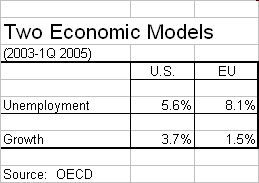
Poor Europe. Not long ago, people like Jeremy Rifkin were touting it as the Next Big Thing. Now the Euro is falling, and everyone is pointing out problems. . .The WSJ offers this speaks-for-itself table:1
At any rate, it's hard to dispute this point [quoting today's excellent WSJ editorial]: "European nations penalize work and subsidize non-work, and, no surprise, they have gotten a lot of the latter and far too little of the former. By contrast, the U.S. model--allegedly cruel and "laissez-faire"--has done much better both by economic growth and worker opportunity."

Wealth and Job Creation: U.S. vs Europe (EU 15)
Again, I favor integration of a strong Europe--so long as the electorate, not the elites, of each country select the appropriate economic and regulatory model.
More:
Jonah Goldberg:
In recent years the entire EU project — at least in Western Europe — has taken on an anti-American flavor. Gerhard Schroeder and Jacques Chirac — the lame duck and electorally doomed leaders of Germany and France, respectively — have kept their political engines running on the fumes of anti-Americanism in recent years. The EU project has been sold as a means of counterbalancing the American “hyperpower,” as the French call it. . ._____________
The EU Constitution didn’t fail because of widespread pro-American sentiment. It failed because French and Dutch voters saw their national — and personal — interests at odds with the constitution. The last thing we should do is distract European voters’ attention away from the economy, immigration, and the like by making them angry at us. Gloating would only invite precisely the sort of anti-American pique Chirac and Schroeder have exploited since before the Iraq war. . .
The French have absurdly lavish social-welfare policies, particularly for the middle class and for workers. Opening France to more economic competition threatens their cushy perks. (I knew a French businessman who wanted to fire a lousy truck driver who kept missing work. He had to make an appointment with government bureaucrats six weeks in advance in order to get permission to fire his own employee.)
This points to one of the great ironies of globalization: It imposes a regression to the global mean.
1 Although I'm unable to find the specific OECD source, these OECD data are nearly identical.
Fat Lady Singing
From the June 4th Economist, lead editorial:
For those who fancied that they were building a United States of Europe, a combined power with more people and a bigger economy than the United States of America, the double “no” to the European Union's constitution from France on May 29th and the Netherlands on June 1st has been a cruel collision with reality.
Yet neither this analysis, nor a string of negative opinion polls, has made the unequivocal noes from France and the Netherlands seem any less shocking. For the first time, voters in two founders of the European project have decisively rejected a European treaty. . . That such big majorities have rejected the constitution points to a profound grassroots dissatisfaction over how Europe's political elites have steered the EU.
The French president, Jacques Chirac, has responded in time-honoured fashion by picking a new prime minister, Dominique de Villepin, as classic a specimen of the elite as it is possible to find. That augurs ill for the conclusions that Europe's leaders will take from the voters' anti-elite message. Too many are still insisting on proceeding with ratification of the constitution elsewhere. Yet the decisive French and Dutch noes have killed the constitution stone dead: there is surely no prospect of these two countries being asked to vote again, as Denmark and Ireland did on previous occasion. To insist that the Danes, Irish, Poles, British and others must still vote is like asking doctors to operate on a corpse in the vain hope of resurrecting it.
Thursday, June 02, 2005
Freedom of Choice
UPDATE below.
A useful admission from blue-state central (also known as Wednesday's New York Times):
(via Indepundit)
More:
MaxedOutMama says I'm naive, citing inmates of Democratic Underground who prefer Radical Islam to Western Civilization.
I've examined that bunch before:
M_O_M, welcome to the dark side. Yet it's not so bleak. Especially with Howard Dean at DNC, the other sort of liberal--the DU liberal?--won't get more than token support between Pittsburgh and Denver.
A useful admission from blue-state central (also known as Wednesday's New York Times):
Prime Minister Ibrahim al-Jaafari, at a news conference in Baghdad, gave a strong endorsement of the role played by "multinational forces," the formal name for the 160,000 foreign troops serving here under American command, including about 140,000 Americans and 20,000 in contingents from some 30 other nations.Maybe the "unjust occupier myth" is over.
In New York, the United Nations Security Council, in a unanimously approved statement, extended the mandate of the American-led forces here beyond the end of this year.
Mr. Jaafari said Iraq's need for outside military assistance, not pre-set deadlines, should determine when American troop withdrawals should start.
"The multinational forces are not occupying forces, they are friendly forces, and they are helping us to establish security, carrying out missions in the interests of the Iraqi people, and under the authority of the government," Dr. Jaafari said. The government, he said, wanted an extension of their mandate "until we have defeated terrorism and restored security across the country."
(via Indepundit)
More:
MaxedOutMama says I'm naive, citing inmates of Democratic Underground who prefer Radical Islam to Western Civilization.
I've examined that bunch before:
As shown by Ann Coulter and Charles Johnson, much of the left is terrified of Christianity, indifferent to Judaism--but staunch defenders of Islam. The left loathes mixing religion and politics--but Muslims get a "pass." Invoking Christ is forbidden, but the student commencement address at Harvard is titled "American Jihad." Though Islam may, technically, qualify as a religion, liberals apparently are willing to cooperate with any group seeking America's destruction. And they soft-pedal criticism of Islamic terrorism, even though core liberal rights and values would be the first casualty of Muslim Shari`ah law.The blame America first crowd is frightening. But I'm surprised M_O_M zoomed in on them--what about all the "true liberals" she met once, maybe 25 years ago? ;>)
That's why many lefties supported Yassir Arafat and Fallujah thugs. That's why many in the media call terrorism a myth and America a menace. That's why academics rush to blame America first, eliding criticism of radical Islam. They forget that lambs that sleep with lions risk vanishing before break of day.
The late Michael Kelly—"devoted husband, adoring father and one hellacious journalist"—detested Americans who retained their socialist ideology long after the Soviet Union crumbled:At some point it becomes a seriously immoral act to refuse to acknowledge the truth. At some point, you have to ask whether it is morally acceptable to regard those who yet refuse to come to terms with communism other than as people who have chosen to adhere to known evil. And that point has been long passed.Three-thousand vaporized victims wasn't enough to teach the left to recognize, much less confront, evil. "Oh when will they ever learn?" Probably not before these sheep are devoured by Islamic lions.
M_O_M, welcome to the dark side. Yet it's not so bleak. Especially with Howard Dean at DNC, the other sort of liberal--the DU liberal?--won't get more than token support between Pittsburgh and Denver.
Euro Blame Game
The wicked witch of Western Europe, EU communications commissioner Margot Wallström, today floated plan "B". Confusingly, she calls it plan "D" (oh those wacky Euro-crats). Her idea? Say it again, only louder:
Remaining Euro-crats are finger-pointing, but they're not aiming at condescending elites, Valéry Giscard d'Estaing, or Jacques Chirac. Instead, Brussels blames bloggers, and one in particular: Marseille high school teacher Etienne Chouard, whose French-language website includes a 26-page, 48 footnote, essay urging a Non. My (rudimentary) translation of his five reasons for rejection:
The Washington Post called Chourad "something of a folk hero to the No campaign." (Nicolas Vanbremeersch, part of the Publius group blog, and Dutch blogger Steeph, also were influential.) So why blame bloggers? According to the BBC:
Bitching about blogs won't repair the Euro-wreck. The Constitution can't merely be tweeked or patched; it should be scrapped. As the Wall Street Journal observed, the American Constitution starts with stirring words, "We the People of the United States." By contrast, the EU Constitution begins: "His Majesty the King of the Belgians . . ." Anyone still awake?
The EU Observer quotes Søren Winther Lundby, who runs the center-left "New Europe" think-tank, pronouncing, "[t]he EU has reached a stage, where only the citizens can guarantee a new impetus for Europe." Quite the revelation; participatory government reflecting the people's will--what a novel concept! The sole surprise is French and Netherlands voters demanding a democracy injection before the elite even realized Europe was sick.
More:
Two articles in Thursday's The Times (London):
Speaking later at an extraordinary meeting of the constitutional affairs committee in the European Parliament, the Swede said Plan D would mean being "better at listening ... and better at explaining to citizens."Remember, Wallström heads the EU's office of Institutional Relations and Communication; "she has been directly involved in efforts to make up the gap between the European integration process and EU citizens." A few days ago, she called the treaty negotiations, "the most open and transparent process we have ever had." She now insists, "we have listened and that we have learned something." Uh, Margot, form a sentence with these words: "horse," "barn-door," "closing." Time limit for answering: "200 years or President Chirac's immunity from prosecution, whichever is longer."
Remaining Euro-crats are finger-pointing, but they're not aiming at condescending elites, Valéry Giscard d'Estaing, or Jacques Chirac. Instead, Brussels blames bloggers, and one in particular: Marseille high school teacher Etienne Chouard, whose French-language website includes a 26-page, 48 footnote, essay urging a Non. My (rudimentary) translation of his five reasons for rejection:
- A Constitution must be readable by the voters: this text is illegible.
- A Constitution is procedural, without imposing one policy or another: this text enshrines everything.
- A Constitution can be amended: this text is yoked to the "double unanimity" requirement (Amendments require unanimous approval from 25 member governments plus their parliaments).
- A Constitution protects from tyranny by the separation of, and constraints on, power: this text neither separates nor truly limits power.
- A Constitution is not ordained from above, it is enacted by the people themselves as protection from state power and caprice, achieved via the people's representatives, themselves subject to recall by periodic elections: this text enshrines fifty year-old European institutions already acting as both judge and jury.
The Washington Post called Chourad "something of a folk hero to the No campaign." (Nicolas Vanbremeersch, part of the Publius group blog, and Dutch blogger Steeph, also were influential.) So why blame bloggers? According to the BBC:
The "Yes" campaigners argued that the blogs were perpetuating myths and half-truths, French internet consultant Stanislas Magniant told the BBC.Attempting a second (rudimentary) translation from BBC-speak: Accustomed to a lap-dog MSM, Brussels blames bloggers for prevailing.
But those opposed to the constitution found the internet in general and blogs in particular as one of the ways to get their message out, he said.
"Proponents of 'No' have said the mainstream media have been shamelessly in favour of the 'Yes'. They said the internet was the main area where the democratic debate can take place," he added.
Bitching about blogs won't repair the Euro-wreck. The Constitution can't merely be tweeked or patched; it should be scrapped. As the Wall Street Journal observed, the American Constitution starts with stirring words, "We the People of the United States." By contrast, the EU Constitution begins: "His Majesty the King of the Belgians . . ." Anyone still awake?
The EU Observer quotes Søren Winther Lundby, who runs the center-left "New Europe" think-tank, pronouncing, "[t]he EU has reached a stage, where only the citizens can guarantee a new impetus for Europe." Quite the revelation; participatory government reflecting the people's will--what a novel concept! The sole surprise is French and Netherlands voters demanding a democracy injection before the elite even realized Europe was sick.
More:
Two articles in Thursday's The Times (London):
President Chirac of France, anxious to avoid the blame for killing the constitution, wrote to the EU’s other heads. “While nine countries have already approved it, all the other member states should now state their views on this treaty,” he said.
But Poland and the Czech Republic, two countries that had been planning to hold referendums, both showed signs of wavering. And while Tony Blair maintained a tactical silence last night, close allies had already made clear his view that the ratification process should be abandoned. . .
Anthony Browne, Europe Correspondent of The Times, said today: "The treaty can only progress if France and the Netherlands find a way of overturning their vote. Until then - and this is being quietly expressed by the British Government in particular - it is pointless to continue with the ratification process.
"President Chirac and Prime Minister Balkenende are both urging the other nations to press ahead with the process because neither wants their nation to be seen as the assassin which killed Europe. But this is beginning to look like a case of the emperor's new clothes - everyone can see that the constitution is dead, but no one wants to say so."
The closest any European leader came to suggesting that the constitutional emperor may in fact be naked was Giulio Tremonti, the Italian Deputy Prime Minister, who said: "I think that the European Constitution as it has been presented and managed is finished. After a popular vote such as took place in France and the Netherlands, I see no alternative, technically or politically."
Your Money or Your Mistress
Is nothing sacred in Europe? According to The Scotsman:
(via Overlawyered)
Spanish business leaders are being told they have to declare any illicit love affairs - to the stock market.The proposed law also compels disclosure of homosexual relationships, potentially "outing" businessmen's gay lovers. The El Mundo newspaper denounced what it called a "impossible stock market inquisition":
In an attempt to crack down on insider trading, the directors of companies quoted on Spain’s stock exchange will have to come clean, on a twice-yearly basis, about anyone with whom they are having an "affectionate relationship".
In July, legislation will be brought in by the regulatory body, the Comisión Nacional del Mercado de Valores (CNMV), to try to clean up the image of Spanish business practices.
Privileged information about share prices, takeovers and company results is frequently leaked from the companies involved, and the CNMV hopes the government-backed move will help to make dealings more transparent.
Where is this register of partners and lovers to be? What constitutional precept allows such an invasion of privacy?Spanish authorities blame the EU: "It is also now part of the international accounting norms that have been applied in the EU since January 1." Another good reason to ax the EU.
(via Overlawyered)
European Constitution, 2000 - 2005
David Carr aims to bury, not praise over at Samizdata:
As much as any analysis of the Constitution is possible at all, then the final one must be that she was a puzzle draped in an enigma. Even those closest to her admitted that she was difficult to read and even harder to interpret. Despite all earnest attempts to present her as something coherent and friendly, she remained stubborney opaque and inpenetrable; a capricious, whimsical, moody, temperamental, volatile, eccentric, arbitrary, erratic, fickle, inconstant coquette whose last act of defiance is to take her unfathomable mysteries with her to the grave.(via Instapundit)
The Constitution will be greatly missed by her many friends and admirers, and especially those among them who believed her to be the lifetime meal ticket they were yearning for.
Details will be published shortly of all ecumenical, humanist, non-denominational memorial services to be held in Brussels and Strasbourg.
Wednesday, June 01, 2005
QOTW
Charles Krauthammer in the June 1st Time magazine:
The Op-Ed pages are filled with jeremiads about believers--principally evangelical Christians and traditional Catholics--bent on turning the U.S. into a theocracy. Now I am not much of a believer, but there is something deeply wrong--indeed, deeply un-American--about fearing people simply because they believe. It seems perfectly O.K. for secularists to impose their secular views on America, such as, say, legalized abortion or gay marriage. But when someone takes the contrary view, all of a sudden he is trying to impose his view on you. And if that contrary view happens to be rooted in Scripture or some kind of religious belief system, the very public advocacy of that view becomes a violation of the U.S. constitutional order.(via Right Wing News)
Righty Round Up
John Hawkins, the clear-eyed blogger behind Right Wing News started a second web page called Conservative Grapevine. Conservative Revolution calls it "a news aggregator from the right side of the blogosphere." I say it's damn good; a perfect complement to morning coffee. Thank you John. Try it today.
In accordance with possible FEC regulations, no money changed hands in connection with this post.
In accordance with possible FEC regulations, no money changed hands in connection with this post.
Who Armed Iraq?
The anti-war left claims Saddam's weapons -- conventional and WMD -- came from the U.S. The tin-foil hat brigade touts this alleged hypocrisy as somehow negating justification for the Invasion. This notion is nonsensical, as Christopher Hitchens (and others) argue: if America armed Saddam, America had an especial responsibility to depose him.
In any event, the "it's America's fault" meme is largely a myth. Though the U.S. sold dual-use chemicals to Iraq, the amount is exaggerated. Moreover, those chemicals were mostly not precursors to any chemical weapons Iraq deployed or used. (The US consistently condemned their use in warfare.) And U.S. sales were trivial compared to others. James Ruhland sourced Iraq's weapon inventory at the time of the first Gulf War (90-91)--none came from America. Moreover, in early 2003, Admiral Quixote created two charts based on data from Stockholm International Peace Research Institute:

Saddam's Sources (click to enlarge)

Saddam's Sources With A UN Veto (click to enlarge)
When Saddam was toppled, Iraq's largest sovereign debt was to Russia ($25 billion), France ($5 billion) and China ($5 billion); as Stephen Green commented, "Is it any coincidence that these are three of the loudest voices against us getting into Saddam's filing cabinets?"
To that evidence, we can add another contemporaneous study, noticed at Cao's Blog and linked to by GM's Corner. The report, titled Project Babylon: Who Armed Iraq?, was published in the April 2003 Investigate Magazine (Australian/New Zeeland):
In any event, the "it's America's fault" meme is largely a myth. Though the U.S. sold dual-use chemicals to Iraq, the amount is exaggerated. Moreover, those chemicals were mostly not precursors to any chemical weapons Iraq deployed or used. (The US consistently condemned their use in warfare.) And U.S. sales were trivial compared to others. James Ruhland sourced Iraq's weapon inventory at the time of the first Gulf War (90-91)--none came from America. Moreover, in early 2003, Admiral Quixote created two charts based on data from Stockholm International Peace Research Institute:

Saddam's Sources (click to enlarge)

Saddam's Sources With A UN Veto (click to enlarge)
When Saddam was toppled, Iraq's largest sovereign debt was to Russia ($25 billion), France ($5 billion) and China ($5 billion); as Stephen Green commented, "Is it any coincidence that these are three of the loudest voices against us getting into Saddam's filing cabinets?"
To that evidence, we can add another contemporaneous study, noticed at Cao's Blog and linked to by GM's Corner. The report, titled Project Babylon: Who Armed Iraq?, was published in the April 2003 Investigate Magazine (Australian/New Zeeland):
The WMD (weapons of mass destruction) trail begins in 1975 when Saddam Hussein – at that stage still the Vice President of Iraq - joined forces with French Prime Minister (now President) Jacques Chirac in a deal to purchase French military equipment and armaments.The report also relates some accounts of torture and rape under the Saddam regime--for the strong-willed only.
Hussein had, only weeks earlier, signed an agreement with the Soviet Union to purchase a nuclear reactor facility from the Russians, but the Soviet deal contained a catch: Russia was insisting on safeguards to ensure that fuel from the reactor could not be reprocessed to make nuclear weapons. Saddam was hoping he could get a better deal out of France.
Jacques Chirac sent an arms negotiation team to Iraq on March 12, 1975, who offered up to 72 of the then state-of-the-art Mirage jet fighters, as well as 40 German Dornier jets (West Germany, in 1975, was still under a United Nations ban on exporting weapons, imposed after WW II, and channelled their defence sales through France to undermine the UN sanction).
The French, for their part, were desperate to source cheap oil from Iraq in order to maintain their overall share of the world oil market. Saddam needed weapons and the ability to manufacture them under license in Iraq; France needed Iraqi oil. It was, noted commentators at the time, a marriage made in heaven. . .
A year later, in 1976, Saddam Hussein was pushing for chemical weapons manufacture as well. The French Prime Minister again helped out, opening doors for Iraq in the United States. Because of its reputation for supporting terrorism, Iraq was on the US banned list, but by going through France it was hoping to bypass US restrictions. The "personal friend" of M’sieur Chirac was introduced to a French engineering company with a subsidiary branch in the US. That branch called on a New York chemical equipment company, Pfaudler & Co, and told them Iraq needed to build a pesticide factory because "Iraqi farmers are unable to protect their crops from the ravages of desert locusts and other pests".
This seemed like a reasonable request, and Pfaudler sent staff to Iraq to begin work on the project. The US company pulled out of the deal several months later when it became apparent that Iraq wanted to manufacture 1,200 tonnes of Amiton, Demeton, Paraoxon and Parathion – highly toxic organic compounds that can be converted into nerve gas. . .
Having constructed its "pesticides" factory, Iraq began purchasing raw materials for it in July 1983. The first shipment, 500 tonnes of thiodiglycol – an ingredient of mustard gas – was sourced through a Dutch company, which went on to supply many hundreds of tonnes more. The Dutch company acted as a ‘front’, ordering the chemicals in from the US. That particular deception wasn’t discovered by US authorities until 1986, three years after the first chemical weapons had been used by Iraqi forces against Iran. But US intelligence agencies had acted swiftly after the first gas attacks in December 1983, and a report to the US Government in early 1984 recommended the immediate imposition of export controls on chemicals that could be used in weapons. Iraq and Iran were the first on the banned list, but the warring nations went through so many middlemen that eventually the banned list included the entire world, save for 18 Western nations.
That's Two!
The "nees" have it: with turn-out over 62 percent, exit polls show voters in the Netherlands overwhelmingly rejecting the proposed EU Constitution, with a likely margin of 63 to 37 percent.
EU Referendum captures my mood:
More:
According to Zacht Ei and Nos TV: With 99.8 percent of all votes counted, 61.6 percent NO, 38.4 percent yes. The turnout was 62.8; higher than expected.
(via LGF)
Still More:
Tim Hames in the Times (London):
______________
1 EU Commissioner Margot Wallstrom, previously discussed here, the witch incarnate.
EU Referendum captures my mood:
I am not going to gloat.Good news on this side of the Atlantic, says Jonah Goldberg:
I am really not going to gloat - to do so would be immature, irresponsible and grossly unkind to Margot.1 So it is time for a moment of mature reflection.
YEEEEEEEEEEEHAAAAAAHAHAHAAAAAYAAAAAA.....
There, I told you I wasn't going to gloat.
I lied.
Now is the time for unreasonable giddiness, schadenfreude, and rank geopolitical opportunism. Maybe not items one and two, if we're talking about what the offcial US response should be, but for the rest of us, I can't see how this is anything but fantastic news.Ding-dong, the witch is dead.
Though I do think there's little reason to rejoice about the voter's intentions. If I understand the debate in France correctly, it was about whether or not a refrigerator box or a tree house makes for a better place to hide. Oh, wait, that was a different debate. This debate was about whether or not the proposed new EU constitution would result in "ultraliberalism" AKA as "the American" economic model. In other words, both the yes-ers and the no-ers were voting with anti-American attitudes. One group wanted the EU to stick it to America geopolitically. The other group found that part appealing, but was more afraid of becoming like America culturally and economically. In short, I think France remains largely a write-off to us. The good news, however, is that France is now far less positioned to determine the course of European foreign policy generally -- and that's great news.
More:
According to Zacht Ei and Nos TV: With 99.8 percent of all votes counted, 61.6 percent NO, 38.4 percent yes. The turnout was 62.8; higher than expected.
(via LGF)
Still More:
Tim Hames in the Times (London):
The constitution manages the rare feat of being excessively long and disturbingly ambiguous, simultaneously. It is a cross between the Berlin telephone directory and the prophecies of Nostradamus.(via Hatless in Hattiesburg)
______________
1 EU Commissioner Margot Wallstrom, previously discussed here, the witch incarnate.
Tuesday, May 31, 2005
One Man's "Militants" Are Another's Freedom Fighter Fragments
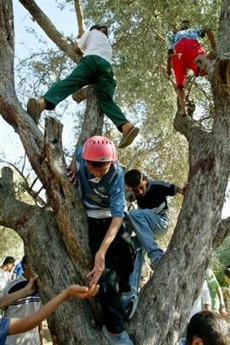
Palestinian children collect body parts of two Palestinian militants of the Al Aqsa Martyrs brigades killed east of Gaza city, Sunday, May 29, 2005. The two militants were killed and three seriously wounded when explosives they were carrying detonated in their car, Palestinians said. (AP Photo/Hatem Moussa)
Why aren't lefties protesting Palestinian child labor? It's obviously another World Bank/WTO-related exploitation of the developing world by shadowy, rich, multi-national corporations--the same ones poisioning our precious bodily fluids.
(via LGF)
Constitution Dream'n; On a Brussels Rainy Day
England Expects rounds-up pols fiddling while Europe burns. My personal favorite is Austrian Foreign Minister Dr. Ursula Plassnik: "the French must tell us what they mean by this vote." Uh, Ursula, baby, what don't you understand about Non? How about: Nein, unmöglichen, nicht eine Wahrscheinlichkeit, keine Wahrscheinlichkeit des Geschehens--keine überhaupt. Das heißt, Fughetaboutit. Get it yet?
As Richard Delevan observes, Ireland's still optimistic; PM Bertie Ahern is:
Delevan's summary is spot-on:
As Richard Delevan observes, Ireland's still optimistic; PM Bertie Ahern is:
[S]till committed to the Constitution and I hope all member states are committed to it. Obviously everyone has an obligation before November of next year to ratify the Constitution, so the process will continue.Which, in my rough translation from Gaelic, means, "the operation was a success, but the patient died."
Delevan's summary is spot-on:
There is much that is good in Europe, and worth fighting for. But the dreaming bureaucrats have so lost touch with the people and their own principles that their arrogance now endangers the whole project.Democracy is the cure for what ails Europe. I hope the medicine arrives in time.
As Expected
Jean-Pierre Raffarin "resigned;" Dominique de Villipin's in as France's new Prime Minister. He's "a moral cretin," but well within one sigma for Frenchmen.
(via reader JMS)
More:
From Wednesday's WSJ:
(via reader JMS)
More:
From Wednesday's WSJ:
Dominique de Villepin's appointment as prime minister yesterday confirms the impression that France faces an extended interregnum. From here on in, the political game will be about the succession to the 72-year-old king, also known as the French president, who nominally holds on to power at the Elysée. In this environment, one can forget about the economic and political changes that France needs to tackle its chronic problems. . .
Still, it is hard to imagine a less inspired choice than Mr. De Villepin. Whatever its other merits or demerits, the referendum marked an upswell of popular democracy, a ringing call that the people want change. In response, Mr. Chirac tapped an aristocrat, a longtime civil servant trained at the fanciest schools who has never held elected office -- and is proud of it. This self-styled poet, historian, Chirac aide de camp, anti-Iraq War crusader hardly looks the man who can speak to "les Français d'en bas," the regular people, who are fed up with insular elites. His promotion from the Interior Ministry was treated by the victorious majority as a slap in the face, and rightly so.
The appointment also sends a distressing signal about the prospects for economic reform. Stagnant growth (under 1% last quarter) and stubbornly high unemployment (at 10.2%) fed the discontent that voters expressed Sunday. The medicine may not be popular, but a courageous leader would take this opportunity to tackle these problems head-on.
Mr. De Villepin doesn't look like the man to even try. His views are fuzzily anti-free-market. Assuming a parliamentary OK for his cabinet -- an if at this point -- he'll lack a popular mandate or the political strength to challenge the vested interests that stand in the way. Smelling blood, trade unions are stepping up their demands for handouts. The planned privatizations of the electricity and gas utilities are in jeopardy. Smelling trouble, the markets sent French stocks and the euro down yesterday.
WFB on GPS
More than 20 years ago, and early in my career, I focused on technical and regulatory issues surrounding radio-determination satellite systems. In the early 80s, the Global Positioning System (GPS) constellation had just been completed (18 out of 24 satellites in orbit), and the DOD was concerned that the Soviets might use GPS signals to aim their ICBMs more precisely at the third button down on President Reagan's starched white shirt. DOD thus degraded the GPS signal to deny precision to the Ruskies. My client proposed to offer more accurate civilian service. A few years of lobbying later, we won an FCC license just when President Reagan committed to ending GPS degradation, a policy ultimately implemented in 2000.
When he isn't writing, thinking, hosting talk shows, and founding and publishing the National Review, William F. Buckely is an amateur sailor. As such, he's a consumer of positioning services, and while reading his literary autobiography this weekend, I stumbled across Buckely on GPS:
Of course, the American electorate did just that in 1992. By then, my client was long gone; bankrupt, its license revoked. De mortuis nil nisi bonum.
When he isn't writing, thinking, hosting talk shows, and founding and publishing the National Review, William F. Buckely is an amateur sailor. As such, he's a consumer of positioning services, and while reading his literary autobiography this weekend, I stumbled across Buckely on GPS:
It is proper to rejoice when reflecting on GPS, but there is a menacing factor in the enterprise, which is called Selective Availability. This means that when the Pentagon feels like it, which is. . .when it feels like it, the signal is degraded, up to three hundred meters. In a fog, that could make the difference between finding the channel entrance and hitting rocks. Why the "dithering," as it is generally called? Answer: national defense. But really, we have a geostrategic affection. The enemy is not going to target our hardened silos by GPS--they'd use inertial guidance, as we do. Moreover, the only world power capable of that kind of aggression right now is still Russia, and the irony here is that they have developed their own GPS system, called Glonass, and it is not degraded, giving the navigator real accuracy. A defense against unreliable signals is the system called Differential GPS. What we have here is beacons scattered along coastal waters. A fifteen-million-dollar Coast Guard operation designed to frustrate the Defense Department. But to tune in on DGPS you need--yet another receiver. As long as Loran is still around, we have the option of dropping GPS and going loran when in menacing areas. There is talk of dropping loran, an event that would leave us at the mercy of an unreliable GPS. If that happens, the only thing to do is exercise selective political availability at the polls.William F. Buckely, Gulf Stream Musings, reprinted in Miles Gone By at 166 (2004).
Of course, the American electorate did just that in 1992. By then, my client was long gone; bankrupt, its license revoked. De mortuis nil nisi bonum.
Monday, May 30, 2005
Man Bites Dog: NOfP Concurs With France
The French electorate has spoken: with voter turnout over 70 percent, 55 percent said Non!

A leftist militant waves a placard reading 'No to the constitution and to (French President Jacques) Chirac's government' in Paris Sunday, May 29, 2005, after early projections suggested that the 'no' bloc had gathered a decisive majority of the votes in a referendum on the European Union's constitution, a result that if confirmed would deal a severe blow to the ambitious efforts to further unite the 25-nation bloc. (AP Photo/Michel Spingler)
According to the Times (London), the French electorate sent,
Even without a re-try, the EU Constitution's like a horror movie monster: so long as a sequel's possible, neither are allowed to die. Indeed, as EU Referendum documents, Eurocrats already launched "plan wiggle-out" based on the suddenly-important "Declaration 30," as detailed in a study by the Instituto Affari Internazionali called "The European Constitution: How to proceed if France or the Netherlands votes 'no'." Though the authors admit the approval process treats "all member states [as] equal as far as ratification (or non-ratification) is concerned. All it takes is one “no” to block it," such simple logic's strictly for suckers:
As previously noted, Sunday's rejection was ironic: citoyen Frog stampeded fearing the Constitution locked-in "Anglo-Saxon" free-market competition--Quelle horreur! The Dutch, who vote this Wednesday, likely will say "nee" because the Constitution's too statist. In fact, the Constitution -- drafted by a commission headed by former French President Valéry Giscard d'Estaing -- would codify, "a centralized bureaucracy, lack of voter accountability, increased red-tape regulation and the probable hostility to competition and free markets."
Who's right, the Dutch or the French? Actually, both. Opponents of all political stripes spotlighted the disconnect between European elites and Europeans. The Economist supported rejection for three reasons:
Sunday's vote is good news. France's rejection allows Europe to re-think their atrophied democracy and present preference for government over liberty. Should the EU try again, Americans willingly would share the first three words of our Constitution: "We the People."
This post also is available at Blogger News Network.

A leftist militant waves a placard reading 'No to the constitution and to (French President Jacques) Chirac's government' in Paris Sunday, May 29, 2005, after early projections suggested that the 'no' bloc had gathered a decisive majority of the votes in a referendum on the European Union's constitution, a result that if confirmed would deal a severe blow to the ambitious efforts to further unite the 25-nation bloc. (AP Photo/Michel Spingler)
According to the Times (London), the French electorate sent,
a message of defiance to their own political establishment and leaving European plans for closer integration in tatters.Alas, Chirac isn't quitting, nor is the Constitution (much less the EU) doomed. The EU's current president, Jean-Claude Juncker, already proposed re-voting. True, French prime minister Jean-Pierre Raffarin previously rejected a second vote. But Raffain's about to be ex-prime minister and his possible successors (Interior Minister Dominique de Villepin and Defense Minister Michele Alliot-Marie) might well declare a "do-over;" they've done it before.
The result was announced by a sombre President Chirac [English translation here], who had personally called the referendum and thrown his political weight behind a document meant to lay down the rules for European cooperation in the coming decades. . .
“It’s a massive ‘no’, a heavy rejection of the Constitution and a huge humiliation for President Chirac,” said Charles Bremner, Times correspondent in Paris.
M. Chirac is now expected to sack his prime minister, Jean-Pierre Raffarin, and reshuffle his Cabinet in response to the voter rejection. But leading Eurosceptics, including the far right leader Jean-Marie Le Pen, said it was the President himself who should be forced from office.
Even without a re-try, the EU Constitution's like a horror movie monster: so long as a sequel's possible, neither are allowed to die. Indeed, as EU Referendum documents, Eurocrats already launched "plan wiggle-out" based on the suddenly-important "Declaration 30," as detailed in a study by the Instituto Affari Internazionali called "The European Constitution: How to proceed if France or the Netherlands votes 'no'." Though the authors admit the approval process treats "all member states [as] equal as far as ratification (or non-ratification) is concerned. All it takes is one “no” to block it," such simple logic's strictly for suckers:
Declaration no. 30 annexed to the [Constitution] reads: “The Conference notes that if, two years after the [draft Constitution was finalized], four fifths of the Member States have ratified it and one or more Member States have encountered difficulties in proceeding with ratification, the matter will be referred to the European Council.” This statement is important for various reasons. . .But, I hear you say, once any Member State rejects a Constitution requiring unanimity, none of its provisions -- including Declaration 30 -- is or could be binding. After France (or the Netherlands or others) vote "no," the Constitution should be unenforceable and Declaration 30 moot. But never fear, says the Italian think tank (emphasis added):
The first concerns the convening of the European Council. If at least four fifths of the Member States (that is twenty) have ratified the treaty within two years of signature, the European Council is obliged to meet to examine the situation. . . Secondly, and this is the point that interests us, no member state [i.e., the perfidious Albion] may decide to stop the ratification process because, for example, another state has chosen not to ratify. . .
From a legal point of view, the conclusions that can be drawn from Declaration no. 30 are sufficiently precise: . . .
[I]f at least twenty states have ratified the [Constitution] within two years, the member states are called on to do everything possible within the European Council to safeguard the future of the [Constitution] or at least its contents.
There is no point in objecting that Declaration no. 30, in that it is annexed to the [Constitution], has no legal value until the [Constitution] enters into force. It is obvious that there are provisions, even in treaties subject to ratification, that become effective from the time the treaty is signed. This is true of those relative to ratification and entry into force of the treaty or conduct pending the latter (Art 24.4 of the Vienna Convention on the Law of Treaties). Nor can it be said that a declaration like the one in question is not binding in that it is a mere expression of intent. The legal value of a declaration annexed to a treaty does not depend on its denomination but rather on its content.Even for the EU, this is astoundingly lawless, authoritarian and anti-democratic. Though Humpty Dumpty hermeneutics might be appropriate "Through the Looking Glass," it's hardly the stuff of representative government. And the Vienna Convention "pre-authorizes" only provisions about ratification; obviously, a country rejecting the Constitution cannot be bound by Council actions authorized under Declaration 30.
As previously noted, Sunday's rejection was ironic: citoyen Frog stampeded fearing the Constitution locked-in "Anglo-Saxon" free-market competition--Quelle horreur! The Dutch, who vote this Wednesday, likely will say "nee" because the Constitution's too statist. In fact, the Constitution -- drafted by a commission headed by former French President Valéry Giscard d'Estaing -- would codify, "a centralized bureaucracy, lack of voter accountability, increased red-tape regulation and the probable hostility to competition and free markets."
Who's right, the Dutch or the French? Actually, both. Opponents of all political stripes spotlighted the disconnect between European elites and Europeans. The Economist supported rejection for three reasons:
First, it cuts down on the range of political choices open to national electorates—and thus is anti-democratic and liable to provoke a backlash. Second, the EU is capable of producing some remarkably awful policies, which because of its consensual way of policymaking become almost impossible to change once established and eventually risk discrediting the whole project. . . Finally, it is more likely that good policy will be promoted in Europe by the power of example than by fiat from Brussels.The Weekly Standard's Bill Kristol agrees and he's optimistic about post-rejection Europe:
It's hard for Americans to appreciate just how just how out-of-touch the establishment (and it really is a single establishment) of Paris, Berlin, the Hague, and Brussels is. Its arrogance almost beyond belief. . .The EU's better off without a Constitution, or at least unencumbered by the current, 448 article, beast. Countries still planning a vote shouldn't slip Constitutional implementation through the legislative back door. This is one monster that should be allowed to die.
Holland's Europe minister, Atzo Nicolai, a supporter of the constitution, acknowledges that "people say that too many important changes have been made without real debate--and they are right about that." So the debate over the constitution opens up the prospect for a broader debate, and a chance for wider rethinking--of Europe's failing welfare states and growth-stultifying, upward-mobility-denying economies; of its failing immigration and multiculturalism policies; of its anti-Americanism and coolness to the cause of freedom and democracy around the world; of its failure to be serious about the threats confronting it and us. All of these are now legitimate subjects of public discussion.
Sunday's vote is good news. France's rejection allows Europe to re-think their atrophied democracy and present preference for government over liberty. Should the EU try again, Americans willingly would share the first three words of our Constitution: "We the People."
This post also is available at Blogger News Network.
Sunday, May 29, 2005
A Tale of Two Arabs
A week ago, I posted excerpts from a WSJ op-ed by Ali al-Ahmed, director of the Saudi Institute in Washington, who personifies an "Arab moderate":
[W]here I come from [Christians] are not even allowed to own a copy of their holy books. . . As Muslims, we have not been as generous as our Christian and Jewish counterparts in respecting others' holy books and religious symbols. Saudi Arabia bans the importation or the display of crosses, Stars of David or any other religious symbols not approved by the Wahhabi establishment. . .Well, al-Ahmed's dark-side doppelganger, Haroon Siddiqui (former Editorial page chief for the Toronto Star), published Koran flushing Q & As in Thursday's Totonto Star:
The lesson here is simple: If Muslims wish other religions to respect their beliefs and their Holy book, they should lead by example.
Q: Political opportunists in Pakistan and elsewhere hijacked the Qur'an incidents to whip up public fury.It's kinda hard to choose from such rich material, but here's my Siddiqui Top 6:
A: Don't our politicians exploit every chance to advance their agenda and themselves, often at the expense of the common good? Aren't George W. Bush and other Republicans particularly adept at using religious and moral wedge issues?
Q: Muslims should be up in arms about the killing of 17 fellow Muslims in the Qur'an protests.
A: Unlike the impression left of crowds lynching one another, most of those who died were killed in police shootings ordered by the pro-American governments of Gen. Pervez Musharraf and Hamid Karzai. There has been plenty of criticism of that, which is not what Messrs. Friedman and others, shedding crocodile tears, are looking for. What they want is for Muslims to berate Muslims for being Muslim in a way not acceptable to America.
Q: Muslims must condemn "their culture of death," as demonstrated in the Qur'an protests and in suicide bombings, lately in Iraq.
A: Sure. But as a recent study by Robert Pape, professor at the University of Chicago, has shown, suicide bombings are not the exclusive preserve of Muslims. The Tamil Tigers, who happen to be Hindu, have been the leading user of that dastardly weapon. . .
Q: Nobody mounts deadly demonstrations when the Bible or other sacred texts are violated.
A: This point has drawn two responses: the Qur'an plays a far more central role in the lives of Muslims than do the sacred texts for others, and, secondly, it's not the fault of Muslims if other believers, especially in the West, have lost their sense of the sacred (something the new Pope also complains about).
But that misses the greater principle: Having guaranteed freedom of religion, it is not for us to dictate how strongly some people might feel about their faith, so long as they operate within the rule of law.
The protests over the Qur'an episodes have been presented as the utterly incomprehensible actions of illiterate and irrational mobs. They are at one level. But on another, they are understandable — not justifiable but understandable — given the scandalous mistreatment of Muslims in America, Iraq and in Afghanistan, day after day, for more than three years.
- "Sure." What, did you expect me to be surprised? Worried? Jihad is the law throughout Islam, and as common as, say, wife 3 asking "Do you want me to stop at Blockbusters on the way home and pick up a DVD?" "Sure," I say, "but not Ishtar again, or I will be forced to whip you."
- It it's not me, it's the filthy Hindu! Or even the Jooooooooooooossss!
- Your religion forbids killing over trivia, and thus is lost the mandate of heaven. You must turn the dial on the way-back machine, and return to the 11th Century. Then America's foreign policy can revert to mutually assured destruction (MAD)--only this time, the balance of power will be settled by jousts between scimitar-brandishing, ululating, soldiers on camels. The winner will rule Europe and earn a Euro-rape pass, good for 200 years or President Chirac's immunity from prosecution, whichever is longer.
- The Newsweek incident proves Muslims have more freedom of religion than Western infidels. Our Koran is more important than your ancient Bibles (I can never remember: was Jesus the older book and Moses the new one? Or the other way around?), so our government is Constitutionally forbidden to prevent the free exercise of the Islamic Constitutional right to jihad and Jizya. Here in barbarous America, your religion has been expelled from the Capitol temple and, I am told, the prescribed punishment for many murderers now is forbidden! It could never be so in Islamic lands; the way of the desert is but two: "the Dar al-Islam—the "house of Islam" or "house of submission" to God—and the Dar al-Harb, or "house of war"—those who are at war with God," blessed be his name."
- Your foolish neo-cons, insisting Bush isn't a Christian crusader--such will be the end of America. Though the barbarous West's reformed tradition, the Islamic world's excelled in evading modernity and preserving the scriptural theocracy. And, as you know, some Muslims soon will celebrate the most holy of holy days; the one Mohammad himself -- having booked the last space (middle seat, third row from the end; curses unto El Al!) on the Al-Buraq El-Sharif El-Airbus to Jerusalem, when returning water to the sand behind a big rock, shielded by a long wall -- declared, in honor of having been bumped to first class AND pulling into the gate 15 minutes early, the festival of E'r Za'ts el-Ekzun would be held whenever jinn el-Carter visited a chief's tent. And so it has. In a few days, it will be E'r Za'ts el-Ekzun day in Iran. While anointing himself for the celebration, spiritual leader Ayatollah Seyyed Ali Khamenei spoke through the factotum Hasani,
You need to vote for Ali Akbar Hashemi Rafsanjani. This way we will finally be able to have for ourselves the atomic bomb to fairly stand up to Israeli weapons," said Hasani. Freedom, democracy and stupidities of this type cannot be carried over to any part, and these concepts are out of sync with the principles of Islam.
So while America gyrates and sings of "losing its religion," Islam grows ever stronger, blessed be the name of the prophet. - Still, we do tremble, O heathen leader Bush, for we have learned ("our source was the New York Times") of secret powers obtained not through Allah. Newspapers in Los Angeles, Washington, San Francisco, Seattle and Minneapolis confirm your Bush has unworldly powers to project lethal force near or next to oceans thousands of miles distant--and still sparing many in between, mostly apart from coasts. We do not understand this dark wind, activated merely with a mention of "partial birth abortion," "support our troops" or "the sanctity of marriage." I pray to the prophet that, when he next slams the triple-blade switch, fires up the Van der Graph generators, and mysteriously summons lightning at 4:45 pm each Washingon summer day, Bush faces away from Toronto when speaking blasphemous wedgies.
Subscribe to:
Posts (Atom)